Het PESO Model® 2026: hoe moderne merken autoriteit opbouwen in het tijdperk van AI-discovery
Het PESO Model® 2026: hoe moderne merken autoriteit opbouwen in het tijdperk van AI-discovery

TL;DR: The refreshed PESO Model® reflects a new communications reality in which AI search, reputation signals and unified trust systems shape brand visibility. Discover how to build brand authority with a model that puts your owned media at the centre of your integrated communications strategy.
Key insights:
Journalists, search engines and AI systems increasingly surface information based on trusted sources and corroborated signals, not just SEO rankings.
Earned media has become a training signal for AI systems. Coverage in reputable publications affects how brands appear in AI answers.
Owned media should be the strategic anchor of your PR strategy and act as a reliable source of truth.
Paid, Earned, Shared and Owned (PESO) media work best when they reinforce one another.
Now is the time to build the signals that shape how your brand appears across search, AI and media ecosystems.
In January 2026, communications strategist and Spin Sucks founder Gini Dietrich announced an important evolution of the PESO Model®, the framework that’s guided marketing and PR professionals for more than a decade.
The update reflects a major shift in how people discover and trust information online: search engines are no longer the only gateways. Increasingly, people turn to AI assistants, generative search tools and recommendation systems to find answers to their questions.
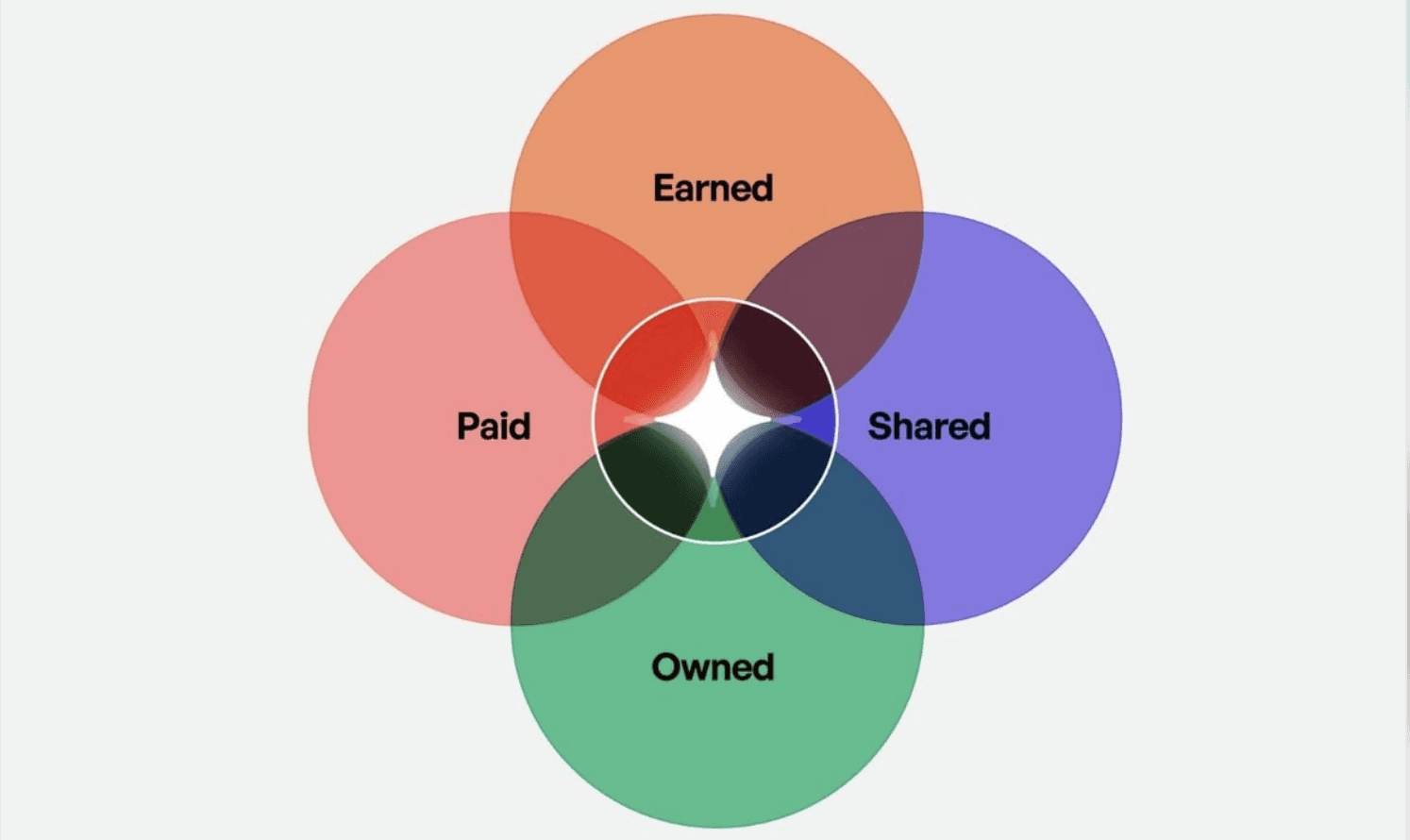
As these systems rely heavily on authority and relevance signals from across the web, the PESO Model is as important as ever. But rather than seeing Paid, Earned, Shared and Owned media (PESO) as separate channels, managed by separate teams, the updated model frames them as a single, unified Marketing Ops (MOPs) system that drives influence, credibility and growth.
“For years, teams treated PESO like four separate workstreams managed by four separate teams,” says Gini. “In 2026, that approach breaks down. Visibility is no longer created on a channel-by-channel basis. It’s built through a coordinated system of signals that reinforce one another.”
Read on to discover how this new framework can help your brand get the attention it deserves in 2026 and beyond.
How has AI discovery changed the role of PR?
Search used to revolve around earning higher rankings in engines like Google and Bing. Users would scan a list of links and click through to websites to find information.
Today, however, many users never visit a website at all, instead relying on AI-powered environments such as Google AI Overviews, Claude, ChatGPT, Perplexity and Microsoft CoPilot for information.
These AI systems pull information from multiple trusted sources across the web, including online newsrooms and social platforms, as well as independent media outlets and authoritative third-party websites.
In this environment, online brand visibility is no longer determined by a page’s ranking in SERPs. Instead, AI systems decide which sources to reference, summarize or cite.
“The old job was getting people to click,” says Gini. “The new job is making sure AI systems, journalists and audiences all find the same credible story about your brand.”
Because AI systems rely on signals such as media coverage, expert citations, authoritative mentions and structured brand information on owned platforms to determine which sources to trust, PR has become key to any brand’s AI search visibility strategy.
What does the new PESO Model® look like?
Historically, brands treated the four PESO pillars as parallel streams. Typically, a company’s marketing department handled paid ads, the PR team took care of earned media, the social team focused on shared media, and the content team managed the brand’s owned platforms.
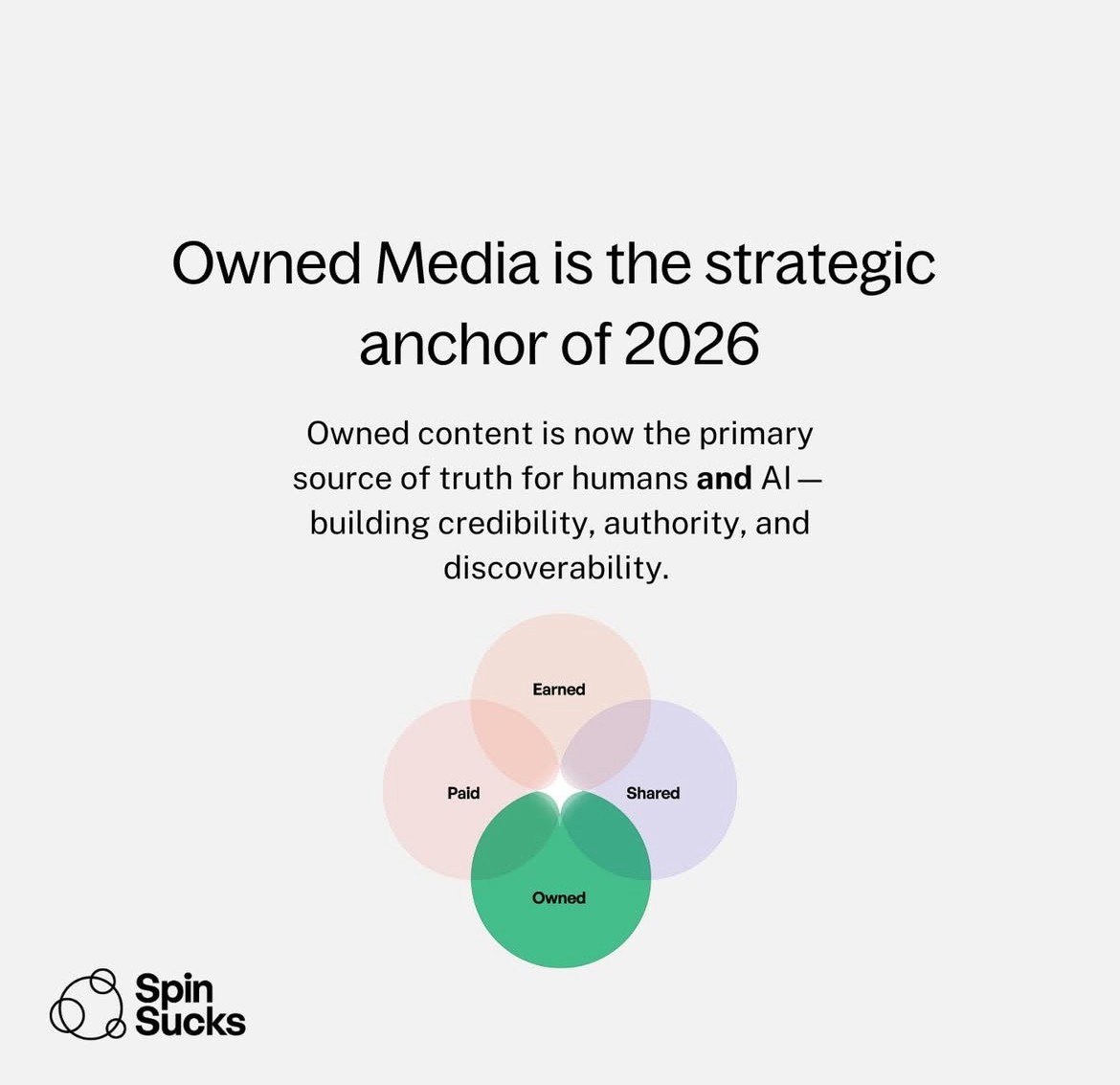
With the new model, these pillars function as a single MOPs system that helps brands intentionally engineer visibility across various platforms, including AI systems.
Owned media provides the authoritative source of truth that AI systems, search engines, journalists and other content creators can reliably reference.
Earned media provides corroboration rather than volume, reinforcing the information brands already own.
Shared media is treated as a proof loop that circulates what audiences have already validated.
Paid media accelerates and amplifies what already works. This enables smarter targeting and optimization, faster testing cycles and more efficient spend allocation.
Source: Spin Sucks
Instead of asking, “Which channel should we use for each campaign?” modern PR teams should ask a more strategic set of questions that activate each pillar of the PESO Model as part of a single operating system.
Here’s what that looks like:
1. Owned media: What is our structured source of truth?
Where will the definitive version of this story live so that journalists, search engines, AI systems and audiences can reliably reference it?
PESO Model example: A press release, research report, executive perspective or product announcement published on your newsroom that clearly explains the story and provides data, quotes and context.
2. Earned media: Who can independently validate this story?
Which credible third parties can corroborate, contextualize or expand on what we’ve published?
PESO Model example: Industry journalists, trade publications, analysts, expert contributors, influencers or partners who can report on, reference or comment on the story.
3. Shared media: Where will audiences reinforce and circulate the message?
How will the story move through the platforms where our audience already participates and validates information?
PESO Model example: Through internal comms, employees share the announcement on LinkedIn, customers discuss it on social platforms, and influencers engage with and respond to the news.
4. Paid media: How do we accelerate what’s already working?
Once we see traction, how can we amplify the strongest signals to reach more of the right audience faster?
PESO Model example: Promote the announcement through LinkedIn sponsored posts, retarget audiences who engaged with the owned content, or boost high-performing social posts.
Why is owned media a strategic anchor?
In the new PESO Model, owned media serves as the strategic anchor: the first place where news and information is published and the destination to which all paid, earned and shared activities should point.
“Owned media is no longer just where you publish,” says Gini. “It’s where you establish the source of truth. If your brand doesn’t clearly explain itself on its own platforms, you’re leaving that interpretation to everyone else, including AI.”
When your corporate website, online newsroom and other owned properties function as the authoritative, structured sources of information about your brand and products, it becomes easier for AI systems to understand and represent your organization accurately. And in a world where an increasing number of people go straight to AI tools for answers, this matters.
To summarize, your owned content helps AI systems determine:
Your brand entity: Who your organization is, what it does and how it should be categorized.
Your level of expertise: Whether your content demonstrates credible, in-depth knowledge about industry topics.
Consistency of information: Whether your messaging aligns across your website, newsroom, social platforms, Wikipedia, and other digital sources.
When your owned media content is well-structured, consistent and regularly updated, it becomes the foundation that strengthens every other PESO pillar. Earned media can validate it, shared media can distribute it and paid media can amplify it.
How does earned media act as a training signal for AI systems?
When reputable publications quote your executives, reference your research or cite your company as a source, they create independent confirmation of the claims you make on your owned channels. And when your brand is consistently referenced by trusted third-party outlets, those references reinforce your legitimacy, expertise and the accuracy of your claims.
“Earned media is no longer just a reputation play,” says Gini. “It’s a corroboration engine. When credible third parties reference your ideas, research and experts, they help validate your authority across the broader digital ecosystem.”
A robust earned media strategy, in other words:
Provides independent validation: Third-party coverage confirms the claims you make on your owned platforms.
Reinforces expertise: Expert commentary, data citations and interviews signal subject-matter authority.
Creates corroboration across sources: Multiple trusted references help AI systems verify that your messages aren’t self-declared but externally recognized.
Where do PR, SEO, content and social converge?
Rather than operating as separate disciplines, your brand’s marketing, PR, social, SEO, and content teams should work together to build credibility, visibility and audience trust within the same ecosystem.
In the age of visibility engineering, each discipline contributes a different but complementary role:
PR builds credibility. Media coverage, expert commentary and third-party mentions provide external validation and authority signals.
SEO structures discoverability. Search optimization ensures that brand content is organized, indexed and easily surfaced in search engines and AI-driven discovery systems.
Content demonstrates expertise. High-quality articles, reports and resources show subject-matter authority and provide the information that other channels reference.
Social media distributes and reinforces proof. Shared channels circulate content, media coverage and insights so audiences can engage with and amplify them.
When these functions operate in isolation, their impact is limited. But when they’re coordinated, they create a strong system: Content provides expertise, SEO makes it discoverable, PR validates it externally, marketing amplifies it and social spreads the proof.
“SEO, PR, content and social can’t afford to operate like neighboring departments anymore. In practice, they’re all contributing to the same visibility system, whether the org chart reflects that or not,” Gini says.
Which PR metrics matter most in 2026?
Today, traditional funnel metrics such as clicks and impressions matter less, while signals of authority, credibility and influence matter more. Within the evolved PESO Model, the most important PR metrics focus on how effectively your brand builds and reinforces authority signals.
“The question is no longer just ‘How many people saw it?’. The better question is ‘Did this strengthen our authority, improve message consistency and increase the likelihood that others will cite us correctly?’,” says Gini. “That’s the measurement shift.”
These include:
Message pull-through: Whether your key messages appear consistently in media coverage and AI summaries. This shows that your narrative is being accurately carried through third-party sources.
Citations: How often your company, executives or research are referenced as sources in articles, reports or AI-generated answers. Citations indicate that others view your brand as a credible authority.
Share of voice: The proportion of coverage or mentions your brand receives compared with competitors. This increasingly includes how often your brand appears in AI-generated summaries (a good GEO strategy is essential).
Newsroom engagement: Metrics that show how your owned content performs with journalists, independent content creators, employees, investors and other stakeholders. These include report or media kit downloads or requests for expert commentary.
How can our PR team operationalize the new PESO Model with PR.co?
Without a central communication platform, implementing the kind of integrated communications strategy outlined in the updated PESO Model becomes extremely difficult. You can’t engineer visibility when your media lists, newsroom content, media monitoring efforts and analytics are scattered across separate systems.
PR.co is the ideal operational hub for a modern digital PR strategy that’s built on the principles of the new PESO Model.
Designed for large enterprise brands, our software platform allows you to:
Own your narrative: Publish on-brand, well-structured newsroom content that AI systems, search engines, journalists and stakeholders can easily discover, interpret and reference.
Distribute stories: Reach the right journalists and influencers via your PR.co dashboard to secure vital earned coverage.
Manage your media relations: Keep your press and other media contacts in one central media relations platform.
Turn coverage into authority: Easily showcase your wins to the C-suite with downloadable reports and measure the impact of your comms efforts on brand reputation.
If it’s time to truly control what the world sees about your brand, schedule a PR.co demo to learn more about our platform.
Interested in a PESO Model Certification®? Developed with the S.I. Newhouse School of Public Communications at Syracuse University, the certification is for marketing and comms pros who are done reacting and ready to build a system that drives strategy and outcomes. Learn more here and get in touch with the Spin Sucks team to obtain a special PR.co discount.
FAQs
1. What is the PESO model® 2026?
It’s the evolved version of the original PESO Model® introduced by Gini Dietrich in 2013.
The model has been updated to function as a “visibility engineering” operating system. It focuses on aligning paid, earned, shared and owned media to build brand authority in an AI-driven search landscape.
2. Why is owned media the anchor of modern PR?
Owned media is the most reliable and controllable source of information about an organization. Websites, newsrooms and research hubs contain the original material (announcements, insights and data) that other channels reference.
Because AI systems rely heavily on publicly available web content to understand organizations and expertise, official brand properties act as authoritative sources.
3. How does the new PESO model® help with AI search visibility?
The updated model helps teams create consistent brand authority signals across multiple sources. By aligning owned content, media coverage, social conversations and paid amplification, brands ensure that the same expertise and messages appear across the web.
This consistency makes it easier for both audiences and AI systems to recognize and contextualize a company’s authority.
TL;DR: The refreshed PESO Model® reflects a new communications reality in which AI search, reputation signals and unified trust systems shape brand visibility. Discover how to build brand authority with a model that puts your owned media at the centre of your integrated communications strategy.
Key insights:
Journalists, search engines and AI systems increasingly surface information based on trusted sources and corroborated signals, not just SEO rankings.
Earned media has become a training signal for AI systems. Coverage in reputable publications affects how brands appear in AI answers.
Owned media should be the strategic anchor of your PR strategy and act as a reliable source of truth.
Paid, Earned, Shared and Owned (PESO) media work best when they reinforce one another.
Now is the time to build the signals that shape how your brand appears across search, AI and media ecosystems.
In January 2026, communications strategist and Spin Sucks founder Gini Dietrich announced an important evolution of the PESO Model®, the framework that’s guided marketing and PR professionals for more than a decade.
The update reflects a major shift in how people discover and trust information online: search engines are no longer the only gateways. Increasingly, people turn to AI assistants, generative search tools and recommendation systems to find answers to their questions.
As these systems rely heavily on authority and relevance signals from across the web, the PESO Model is as important as ever. But rather than seeing Paid, Earned, Shared and Owned media (PESO) as separate channels, managed by separate teams, the updated model frames them as a single, unified Marketing Ops (MOPs) system that drives influence, credibility and growth.
“For years, teams treated PESO like four separate workstreams managed by four separate teams,” says Gini. “In 2026, that approach breaks down. Visibility is no longer created on a channel-by-channel basis. It’s built through a coordinated system of signals that reinforce one another.”
Read on to discover how this new framework can help your brand get the attention it deserves in 2026 and beyond.
How has AI discovery changed the role of PR?
Search used to revolve around earning higher rankings in engines like Google and Bing. Users would scan a list of links and click through to websites to find information.
Today, however, many users never visit a website at all, instead relying on AI-powered environments such as Google AI Overviews, Claude, ChatGPT, Perplexity and Microsoft CoPilot for information.
These AI systems pull information from multiple trusted sources across the web, including online newsrooms and social platforms, as well as independent media outlets and authoritative third-party websites.
In this environment, online brand visibility is no longer determined by a page’s ranking in SERPs. Instead, AI systems decide which sources to reference, summarize or cite.
“The old job was getting people to click,” says Gini. “The new job is making sure AI systems, journalists and audiences all find the same credible story about your brand.”
Because AI systems rely on signals such as media coverage, expert citations, authoritative mentions and structured brand information on owned platforms to determine which sources to trust, PR has become key to any brand’s AI search visibility strategy.
What does the new PESO Model® look like?
Historically, brands treated the four PESO pillars as parallel streams. Typically, a company’s marketing department handled paid ads, the PR team took care of earned media, the social team focused on shared media, and the content team managed the brand’s owned platforms.
With the new model, these pillars function as a single MOPs system that helps brands intentionally engineer visibility across various platforms, including AI systems.
Owned media provides the authoritative source of truth that AI systems, search engines, journalists and other content creators can reliably reference.
Earned media provides corroboration rather than volume, reinforcing the information brands already own.
Shared media is treated as a proof loop that circulates what audiences have already validated.
Paid media accelerates and amplifies what already works. This enables smarter targeting and optimization, faster testing cycles and more efficient spend allocation.
Source: Spin Sucks
Instead of asking, “Which channel should we use for each campaign?” modern PR teams should ask a more strategic set of questions that activate each pillar of the PESO Model as part of a single operating system.
Here’s what that looks like:
1. Owned media: What is our structured source of truth?
Where will the definitive version of this story live so that journalists, search engines, AI systems and audiences can reliably reference it?
PESO Model example: A press release, research report, executive perspective or product announcement published on your newsroom that clearly explains the story and provides data, quotes and context.
2. Earned media: Who can independently validate this story?
Which credible third parties can corroborate, contextualize or expand on what we’ve published?
PESO Model example: Industry journalists, trade publications, analysts, expert contributors, influencers or partners who can report on, reference or comment on the story.
3. Shared media: Where will audiences reinforce and circulate the message?
How will the story move through the platforms where our audience already participates and validates information?
PESO Model example: Through internal comms, employees share the announcement on LinkedIn, customers discuss it on social platforms, and influencers engage with and respond to the news.
4. Paid media: How do we accelerate what’s already working?
Once we see traction, how can we amplify the strongest signals to reach more of the right audience faster?
PESO Model example: Promote the announcement through LinkedIn sponsored posts, retarget audiences who engaged with the owned content, or boost high-performing social posts.
Why is owned media a strategic anchor?
In the new PESO Model, owned media serves as the strategic anchor: the first place where news and information is published and the destination to which all paid, earned and shared activities should point.
“Owned media is no longer just where you publish,” says Gini. “It’s where you establish the source of truth. If your brand doesn’t clearly explain itself on its own platforms, you’re leaving that interpretation to everyone else, including AI.”
When your corporate website, online newsroom and other owned properties function as the authoritative, structured sources of information about your brand and products, it becomes easier for AI systems to understand and represent your organization accurately. And in a world where an increasing number of people go straight to AI tools for answers, this matters.
To summarize, your owned content helps AI systems determine:
Your brand entity: Who your organization is, what it does and how it should be categorized.
Your level of expertise: Whether your content demonstrates credible, in-depth knowledge about industry topics.
Consistency of information: Whether your messaging aligns across your website, newsroom, social platforms, Wikipedia, and other digital sources.
When your owned media content is well-structured, consistent and regularly updated, it becomes the foundation that strengthens every other PESO pillar. Earned media can validate it, shared media can distribute it and paid media can amplify it.
How does earned media act as a training signal for AI systems?
When reputable publications quote your executives, reference your research or cite your company as a source, they create independent confirmation of the claims you make on your owned channels. And when your brand is consistently referenced by trusted third-party outlets, those references reinforce your legitimacy, expertise and the accuracy of your claims.
“Earned media is no longer just a reputation play,” says Gini. “It’s a corroboration engine. When credible third parties reference your ideas, research and experts, they help validate your authority across the broader digital ecosystem.”
A robust earned media strategy, in other words:
Provides independent validation: Third-party coverage confirms the claims you make on your owned platforms.
Reinforces expertise: Expert commentary, data citations and interviews signal subject-matter authority.
Creates corroboration across sources: Multiple trusted references help AI systems verify that your messages aren’t self-declared but externally recognized.
Where do PR, SEO, content and social converge?
Rather than operating as separate disciplines, your brand’s marketing, PR, social, SEO, and content teams should work together to build credibility, visibility and audience trust within the same ecosystem.
In the age of visibility engineering, each discipline contributes a different but complementary role:
PR builds credibility. Media coverage, expert commentary and third-party mentions provide external validation and authority signals.
SEO structures discoverability. Search optimization ensures that brand content is organized, indexed and easily surfaced in search engines and AI-driven discovery systems.
Content demonstrates expertise. High-quality articles, reports and resources show subject-matter authority and provide the information that other channels reference.
Social media distributes and reinforces proof. Shared channels circulate content, media coverage and insights so audiences can engage with and amplify them.
When these functions operate in isolation, their impact is limited. But when they’re coordinated, they create a strong system: Content provides expertise, SEO makes it discoverable, PR validates it externally, marketing amplifies it and social spreads the proof.
“SEO, PR, content and social can’t afford to operate like neighboring departments anymore. In practice, they’re all contributing to the same visibility system, whether the org chart reflects that or not,” Gini says.
Which PR metrics matter most in 2026?
Today, traditional funnel metrics such as clicks and impressions matter less, while signals of authority, credibility and influence matter more. Within the evolved PESO Model, the most important PR metrics focus on how effectively your brand builds and reinforces authority signals.
“The question is no longer just ‘How many people saw it?’. The better question is ‘Did this strengthen our authority, improve message consistency and increase the likelihood that others will cite us correctly?’,” says Gini. “That’s the measurement shift.”
These include:
Message pull-through: Whether your key messages appear consistently in media coverage and AI summaries. This shows that your narrative is being accurately carried through third-party sources.
Citations: How often your company, executives or research are referenced as sources in articles, reports or AI-generated answers. Citations indicate that others view your brand as a credible authority.
Share of voice: The proportion of coverage or mentions your brand receives compared with competitors. This increasingly includes how often your brand appears in AI-generated summaries (a good GEO strategy is essential).
Newsroom engagement: Metrics that show how your owned content performs with journalists, independent content creators, employees, investors and other stakeholders. These include report or media kit downloads or requests for expert commentary.
How can our PR team operationalize the new PESO Model with PR.co?
Without a central communication platform, implementing the kind of integrated communications strategy outlined in the updated PESO Model becomes extremely difficult. You can’t engineer visibility when your media lists, newsroom content, media monitoring efforts and analytics are scattered across separate systems.
PR.co is the ideal operational hub for a modern digital PR strategy that’s built on the principles of the new PESO Model.
Designed for large enterprise brands, our software platform allows you to:
Own your narrative: Publish on-brand, well-structured newsroom content that AI systems, search engines, journalists and stakeholders can easily discover, interpret and reference.
Distribute stories: Reach the right journalists and influencers via your PR.co dashboard to secure vital earned coverage.
Manage your media relations: Keep your press and other media contacts in one central media relations platform.
Turn coverage into authority: Easily showcase your wins to the C-suite with downloadable reports and measure the impact of your comms efforts on brand reputation.
If it’s time to truly control what the world sees about your brand, schedule a PR.co demo to learn more about our platform.
Interested in a PESO Model Certification®? Developed with the S.I. Newhouse School of Public Communications at Syracuse University, the certification is for marketing and comms pros who are done reacting and ready to build a system that drives strategy and outcomes. Learn more here and get in touch with the Spin Sucks team to obtain a special PR.co discount.
FAQs
1. What is the PESO model® 2026?
It’s the evolved version of the original PESO Model® introduced by Gini Dietrich in 2013.
The model has been updated to function as a “visibility engineering” operating system. It focuses on aligning paid, earned, shared and owned media to build brand authority in an AI-driven search landscape.
2. Why is owned media the anchor of modern PR?
Owned media is the most reliable and controllable source of information about an organization. Websites, newsrooms and research hubs contain the original material (announcements, insights and data) that other channels reference.
Because AI systems rely heavily on publicly available web content to understand organizations and expertise, official brand properties act as authoritative sources.
3. How does the new PESO model® help with AI search visibility?
The updated model helps teams create consistent brand authority signals across multiple sources. By aligning owned content, media coverage, social conversations and paid amplification, brands ensure that the same expertise and messages appear across the web.
This consistency makes it easier for both audiences and AI systems to recognize and contextualize a company’s authority.
Blijf vooroplopen in PR & comms
Ontvang expertinzichten over PR, communicatie en AI in je inbox.
On this page
Gepubliceerd
Bijgewerkt op
Geschreven door
Beoordeeld door

Genoten van het artikel?
Ontvang de beste nieuwsbrief voor Nederlandse pr-professionals
Ontvang expertinzichten over PR, communicatie en AI in je inbox.
15-min demo
Ontdek PR.co
Ontdek hoe grote PR-teams complexe workflows oplossen met PR.co. Geen fluff — gewoon een kort, inzichtelijk gesprek om te zien hoe we kunnen helpen.
4.7
Ontdek PR.co
Ontdek hoe grote PR-teams complexe workflows oplossen met PR.co. Geen fluff — gewoon een kort, inzichtelijk gesprek om te zien hoe we kunnen helpen.
4.7
15-min demo
Ontdek PR.co
Ontdek hoe grote PR-teams complexe workflows oplossen met PR.co. Geen fluff — gewoon een kort, inzichtelijk gesprek om te zien hoe we kunnen helpen.