
Why Translations are a Critical Strategy for AI visibility in 2026

Why Translations are a Critical Strategy for AI visibility in 2026

Ana Carrasco

op

1 dec 2025

A small globe on a desk, near a vase with leaves and a photoframe

Key points:

  • Translated content can boost your brand’s AI visibility and help you get your target customers’ attention.​

  • Large Language Models (LLMs) prefer to cite content that’s available in the user’s query language.​

  • Google may auto-translate content in its AI Overviews, which could dilute your messages and result in missed web traffic (and lost opportunities).

  • Good-quality translations can build authority, credibility and backlinks, which leads to higher levels of search and AI discoverability.​

  • Translation and localization help you to control your brand narrative.

Noticed how you no longer click on Google’s SERPs and skip straight to the AI Overviews, or how you now use ChatGPT more often than Google? 

Your behavior reflects what other online users do. It also represents a significant shift in priorities for PR teams that seek visibility for their brands. 

Half of consumers now use AI search, and $750B of consumer spend is set to flow through AI search by 2028. This means the race is on to get your brand’s content cited by AI. 

But to get ahead, you must tick a few new boxes. Is your Wikipedia entry up to date? Does your brand participate in Reddit discussions? Is your content technically structured well and easy to read?

For many busy digital PR teams, it can feel like a tall order to adapt to AI’s needs. Yet the technology has also opened up exciting possibilities. This article explores why translated content can improve AI visibility and offers practical advice on when (or whether) to add translation to your PR to-do list.

Are translated websites more visible to AI models?

There’s research to suggest so. 

A translation company called Weglot studied 1.3 million examples of websites mentioned or cited by AI tools and found that:

  • If a website were only in one language (Spanish, for example), it showed up four times more often in that language than in others.

  • When that same website added good English translations, it suddenly became visible in both languages. In some instances, visibility jumped by more than 327%.

In simple terms, websites that offer content in multiple languages are more often noticed by AI tools. These tools prefer to show results in the same language a person used when they asked the platform a question.

This trend is also reflected in the work of AI Peekaboo, a platform that tracks AI search visibility for global brands. Their team works with companies across the globe, including the United States, Portugal, India, Switzerland and South Africa.

Filipe Lins Duarte, AI Peekaboo's co-founder says they consistently observe that AI tools surface citations in the user’s local language. "According to AI Peekaboo’s analysis, brands that do not publish content in the languages of the markets they want to reach simply do not appear in AI generated answers for those audiences. Their findings underline how translation has become a significant competitive advantage that many organizations still overlook."

There are a few more reasons why it makes sense to translate your content:

  • Google will translate your content if you don’t. Many users no longer skip past Google’s AI Overviews when they search for info, so it’s critical to pay attention to how your brand shows up in these summaries. If Google can’t find good pages about your product or brand in a user’s native language, it doesn’t just skip giving them an answer. It quietly translates the content and displays it in its AI Overviews. This means Google (and not your business) gets the credit and the traffic.

  • Translated content builds authority through backlinks. If native speakers from different regions find your content shareable and relevant, it helps to build authority signals for your brand. More backlinks mean search engines, audiences and Large Language Models (LLMs)start to recognize your website or brand as trustworthy, which can improve your reputation, SEO rankings and AI visibility. 

  • Multilingual PR creates more indexable pages for your brand. When your website pages are in multiple languages, it can boost rankings across language-specific AI search engine results and increase the pool of content that’s available for AI citation. In fact, there’s a strong connection between conventional search rankings and AI citations. Research shows that 76% of AI Overview citations come from pages that rank in Google’s top 10, and 86% come from the top 100

TL;DR: Without a strong, localized content foundation, you could miss out on enormous potential traffic from international audiences. 

You could also lose control over how your brand narrative is shaped and presented in critical markets. Both Google and AI models like ChatGPT will simply take what they can find about your brand, product or service, and translate it. In the process, important nuance could get lost.

A word of caution, though: Poor-quality AI translations can harm your brand’s SEO performance and brand credibility. According to Google’s John Mueller, low-quality translations create poor user experiences that search engines will penalize. And if search engines don’t rank your content, chances are that AI search engine models like ChatGPT and Claude also won’t pay attention.
A small globe on a desk near a vase with leaves and a photo frame

Should my brand prioritize translation?

Translation, when done right, is resource-intensive work. Which begs the question: Can all businesses benefit from translated content? 

The answer is pretty straightforward: if your brand targets international markets beyond English-speaking countries, translation should be part of your multimarket PR strategy. 

If, however, your business is focused on English-speaking markets, translation may not offer significant AI visibility benefits. You’re up against many English-language players, which means translation might not get your brand more relevant eyeballs. Both AI and Google might simply pull content from what’s already out there. 

Pair translation with localization and go all in

If translation makes sense for your brand, it’s essential to commit to it fully. Quickly running a press release through a generic machine translation tool is unlikely to get you the results you seek. It could lead to linguistic errors, misinterpretations of brand messages and a complete loss of cultural nuance. Poor-quality output can also confuse AI search crawlers and create a negative user experience, which can lower user trust. 

Instead, translated content should be treated as a strategic asset and paired with localization. Localized PR considers local references, humor, regulations and formatting elements (e.g., dates and currencies) to ensure content is highly relevant to the regions and markets you serve. A fully localized piece of content feels explicitly crafted for its intended target audience and respects the intricacies of your audience’s language and way of life. 

Localized content also ensures you control your brand narrative across markets. When you strategically translate and deeply localize your content for every relevant region, you dramatically increase the likelihood that Google will index and AI tools will cite it. This reduces the risk of misrepresentations, mistakes, hallucinations and competitors hijacking your brand messages.
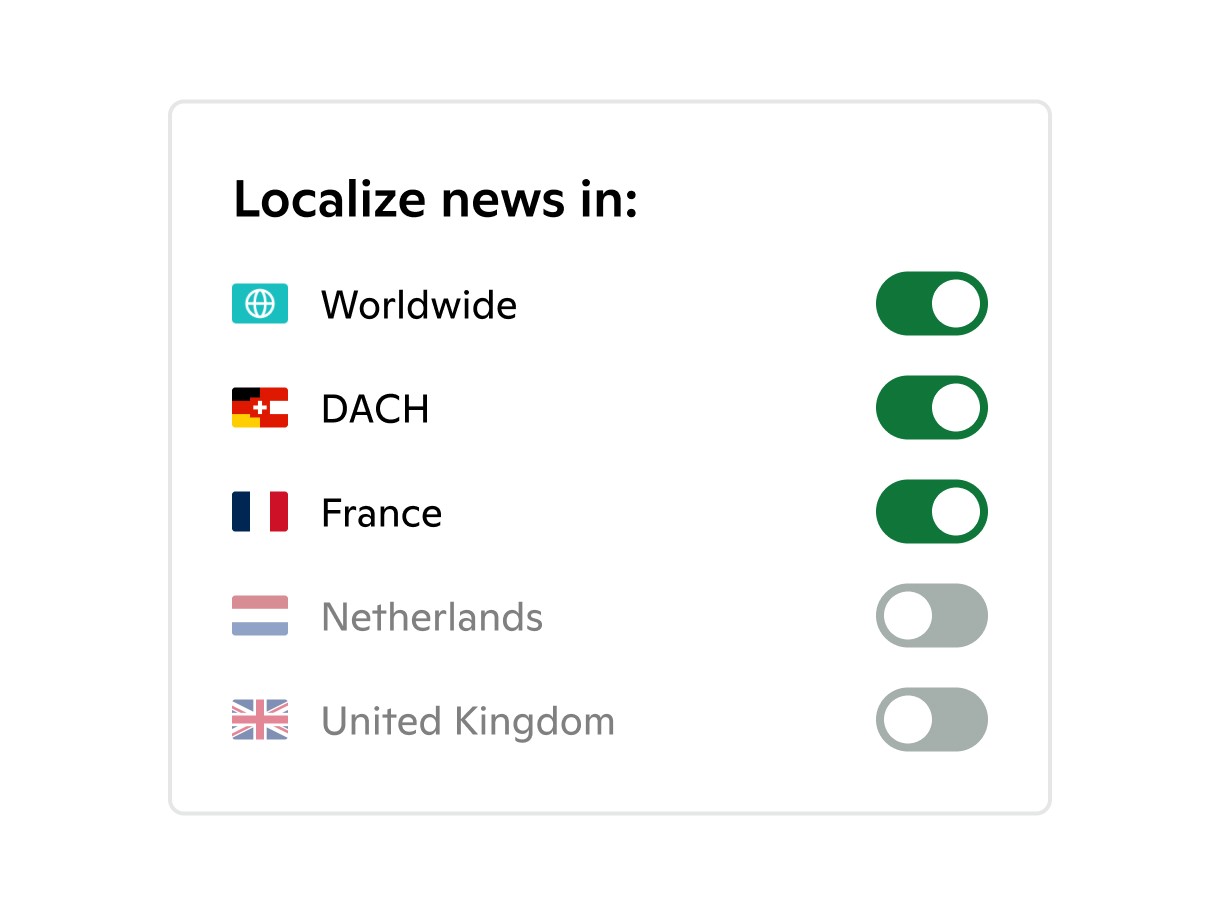
A selector with options to localize news in different markets like Worldwide, DACH, France, Netherlands and United Kingdom

It takes more than translation and localization to improve AI visibility

Translation and localization remain two pieces of a rather large “AI visibility puzzle” that PR pros and marketers across the globe are still trying to build.

Here’s what else to prioritize to boost your chances of getting cited by AI:

  • Traditional SEO. We briefly touched on this before, but it’s important to remember that SEO remains one of the strongest predictors of AI visibility. According to an Ahrefs study, 76.1% of AI Overview-cited pages rank in Google’s top 10 results pages and 9.5% of AI Overview-cited pages rank between positions 11 and 100.

  • Content quality and structure. A study on what makes content more likely to be cited by generative AI systems found that expert quotes (41%), clear statistics (30%), inline citations (30%) and mechanisms that make the text easier to read (22%) play a critical role. Adding these elements to your content should be at the top of your to-do list. Also note that good schema markup helps search crawlers (and AI models) find you. 

  • Third-party engagements and brand mentions. Continue to prioritize your owned content (e.g., your newsroom and blog section) and earned media (PR mentions in trusted sources), both of which matter for AI but play different roles.

Brand mentions in commonly cited, authoritative sources such as Reddit, Quora, Wikipedia and industry publications remain one of the most effective strategies for AI visibility. ChatGPT draws 47.9% of its top citations from Wikipedia alone, while Reddit is a top source for Google AI Overviews. Our article on why Reddit is PR’s most underrated channel unpacks this last point in more detail.

  • Consistent brand messaging: Conduct routine audits to ensure your brand messages align across all published pages and media kits, as outdated information can be quickly surfaced or misinterpreted in AI summaries.

  • Regular citation checks. Regularly track and benchmark your brand’s visibility in AI Overviews and other generative platforms with AI tools like Peekaboo and MorningScore. You’ll quickly see where you perform well and where you need to do more work. 

How a PR.co newsroom helps increase your AI visibility

Generative Engine Optimization (GEO) has made owned media more essential than ever. If you publish owned content that’s well-structured, authoritative, up to date and in your target audience’s language(s), both search engines and AI systems are more likely to pay attention.

Not sure where to start? PR.co’s AI-assisted translations and generative-search-optimized newsrooms can help you adjust your content for international markets and send powerful trust signals to the world’s top LLMs. These features are an integral part of our platform, making it easy to win at the translation game.

Find out why PR.co should form part of your global PR strategy. Book a demo today.

FAQs

  1. How do translations affect my brand’s AI visibility?

Translations make your content available in more languages, which increases the likelihood that AI systems like Google’s AI Overviews and ChatGPT cite your brand. This could lead to higher global reach and boosted brand authority (also great for SEO).

  1. What risks come with poor AI-powered translations?

Low quality, AI-powered translations come with real risks if not reviewed by a real human. They can undermine your SEO and AI visibility, confuse search engines, and ultimately damage your brand’s credibility. Google actively penalizes low-quality or incorrect translations, which means your content is less likely to surface in search, and AI models may overlook your business entirely.

  1. Is translation enough for AI visibility, or do I need to localize my content?

For maximum visibility, simple translation is not enough. You need to localize your content in a way that feels native to the user's language, culture, and search intent. Localized content should also adjust to region-specific terminology, examples, formatting, and context in order to be cited by AI models. By pairing high-quality translations and deep localization, you improve your GEO signals, control your brand narrative across markets, and increase your chances of being (accurately) cited in AI-generated results.

Key points:

  • Translated content can boost your brand’s AI visibility and help you get your target customers’ attention.​

  • Large Language Models (LLMs) prefer to cite content that’s available in the user’s query language.​

  • Google may auto-translate content in its AI Overviews, which could dilute your messages and result in missed web traffic (and lost opportunities).

  • Good-quality translations can build authority, credibility and backlinks, which leads to higher levels of search and AI discoverability.​

  • Translation and localization help you to control your brand narrative.

Noticed how you no longer click on Google’s SERPs and skip straight to the AI Overviews, or how you now use ChatGPT more often than Google? 

Your behavior reflects what other online users do. It also represents a significant shift in priorities for PR teams that seek visibility for their brands. 

Half of consumers now use AI search, and $750B of consumer spend is set to flow through AI search by 2028. This means the race is on to get your brand’s content cited by AI. 

But to get ahead, you must tick a few new boxes. Is your Wikipedia entry up to date? Does your brand participate in Reddit discussions? Is your content technically structured well and easy to read?

For many busy digital PR teams, it can feel like a tall order to adapt to AI’s needs. Yet the technology has also opened up exciting possibilities. This article explores why translated content can improve AI visibility and offers practical advice on when (or whether) to add translation to your PR to-do list.

Are translated websites more visible to AI models?

There’s research to suggest so. 

A translation company called Weglot studied 1.3 million examples of websites mentioned or cited by AI tools and found that:

  • If a website were only in one language (Spanish, for example), it showed up four times more often in that language than in others.

  • When that same website added good English translations, it suddenly became visible in both languages. In some instances, visibility jumped by more than 327%.

In simple terms, websites that offer content in multiple languages are more often noticed by AI tools. These tools prefer to show results in the same language a person used when they asked the platform a question.

This trend is also reflected in the work of AI Peekaboo, a platform that tracks AI search visibility for global brands. Their team works with companies across the globe, including the United States, Portugal, India, Switzerland and South Africa.

Filipe Lins Duarte, AI Peekaboo's co-founder says they consistently observe that AI tools surface citations in the user’s local language. "According to AI Peekaboo’s analysis, brands that do not publish content in the languages of the markets they want to reach simply do not appear in AI generated answers for those audiences. Their findings underline how translation has become a significant competitive advantage that many organizations still overlook."

There are a few more reasons why it makes sense to translate your content:

  • Google will translate your content if you don’t. Many users no longer skip past Google’s AI Overviews when they search for info, so it’s critical to pay attention to how your brand shows up in these summaries. If Google can’t find good pages about your product or brand in a user’s native language, it doesn’t just skip giving them an answer. It quietly translates the content and displays it in its AI Overviews. This means Google (and not your business) gets the credit and the traffic.

  • Translated content builds authority through backlinks. If native speakers from different regions find your content shareable and relevant, it helps to build authority signals for your brand. More backlinks mean search engines, audiences and Large Language Models (LLMs)start to recognize your website or brand as trustworthy, which can improve your reputation, SEO rankings and AI visibility. 

  • Multilingual PR creates more indexable pages for your brand. When your website pages are in multiple languages, it can boost rankings across language-specific AI search engine results and increase the pool of content that’s available for AI citation. In fact, there’s a strong connection between conventional search rankings and AI citations. Research shows that 76% of AI Overview citations come from pages that rank in Google’s top 10, and 86% come from the top 100

TL;DR: Without a strong, localized content foundation, you could miss out on enormous potential traffic from international audiences. 

You could also lose control over how your brand narrative is shaped and presented in critical markets. Both Google and AI models like ChatGPT will simply take what they can find about your brand, product or service, and translate it. In the process, important nuance could get lost.

A word of caution, though: Poor-quality AI translations can harm your brand’s SEO performance and brand credibility. According to Google’s John Mueller, low-quality translations create poor user experiences that search engines will penalize. And if search engines don’t rank your content, chances are that AI search engine models like ChatGPT and Claude also won’t pay attention.

A small globe on a desk near a vase with leaves and a photo frame

Should my brand prioritize translation?

Translation, when done right, is resource-intensive work. Which begs the question: Can all businesses benefit from translated content? 

The answer is pretty straightforward: if your brand targets international markets beyond English-speaking countries, translation should be part of your multimarket PR strategy. 

If, however, your business is focused on English-speaking markets, translation may not offer significant AI visibility benefits. You’re up against many English-language players, which means translation might not get your brand more relevant eyeballs. Both AI and Google might simply pull content from what’s already out there. 

Pair translation with localization and go all in

If translation makes sense for your brand, it’s essential to commit to it fully. Quickly running a press release through a generic machine translation tool is unlikely to get you the results you seek. It could lead to linguistic errors, misinterpretations of brand messages and a complete loss of cultural nuance. Poor-quality output can also confuse AI search crawlers and create a negative user experience, which can lower user trust. 

Instead, translated content should be treated as a strategic asset and paired with localization. Localized PR considers local references, humor, regulations and formatting elements (e.g., dates and currencies) to ensure content is highly relevant to the regions and markets you serve. A fully localized piece of content feels explicitly crafted for its intended target audience and respects the intricacies of your audience’s language and way of life. 

Localized content also ensures you control your brand narrative across markets. When you strategically translate and deeply localize your content for every relevant region, you dramatically increase the likelihood that Google will index and AI tools will cite it. This reduces the risk of misrepresentations, mistakes, hallucinations and competitors hijacking your brand messages.

A selector with options to localize news in different markets like Worldwide, DACH, France, Netherlands and United Kingdom

It takes more than translation and localization to improve AI visibility

Translation and localization remain two pieces of a rather large “AI visibility puzzle” that PR pros and marketers across the globe are still trying to build.

Here’s what else to prioritize to boost your chances of getting cited by AI:

  • Traditional SEO. We briefly touched on this before, but it’s important to remember that SEO remains one of the strongest predictors of AI visibility. According to an Ahrefs study, 76.1% of AI Overview-cited pages rank in Google’s top 10 results pages and 9.5% of AI Overview-cited pages rank between positions 11 and 100.

  • Content quality and structure. A study on what makes content more likely to be cited by generative AI systems found that expert quotes (41%), clear statistics (30%), inline citations (30%) and mechanisms that make the text easier to read (22%) play a critical role. Adding these elements to your content should be at the top of your to-do list. Also note that good schema markup helps search crawlers (and AI models) find you. 

  • Third-party engagements and brand mentions. Continue to prioritize your owned content (e.g., your newsroom and blog section) and earned media (PR mentions in trusted sources), both of which matter for AI but play different roles.

Brand mentions in commonly cited, authoritative sources such as Reddit, Quora, Wikipedia and industry publications remain one of the most effective strategies for AI visibility. ChatGPT draws 47.9% of its top citations from Wikipedia alone, while Reddit is a top source for Google AI Overviews. Our article on why Reddit is PR’s most underrated channel unpacks this last point in more detail.

  • Consistent brand messaging: Conduct routine audits to ensure your brand messages align across all published pages and media kits, as outdated information can be quickly surfaced or misinterpreted in AI summaries.

  • Regular citation checks. Regularly track and benchmark your brand’s visibility in AI Overviews and other generative platforms with AI tools like Peekaboo and MorningScore. You’ll quickly see where you perform well and where you need to do more work. 

How a PR.co newsroom helps increase your AI visibility

Generative Engine Optimization (GEO) has made owned media more essential than ever. If you publish owned content that’s well-structured, authoritative, up to date and in your target audience’s language(s), both search engines and AI systems are more likely to pay attention.

Not sure where to start? PR.co’s AI-assisted translations and generative-search-optimized newsrooms can help you adjust your content for international markets and send powerful trust signals to the world’s top LLMs. These features are an integral part of our platform, making it easy to win at the translation game.

Find out why PR.co should form part of your global PR strategy. Book a demo today.

FAQs

  1. How do translations affect my brand’s AI visibility?

Translations make your content available in more languages, which increases the likelihood that AI systems like Google’s AI Overviews and ChatGPT cite your brand. This could lead to higher global reach and boosted brand authority (also great for SEO).

  1. What risks come with poor AI-powered translations?

Low quality, AI-powered translations come with real risks if not reviewed by a real human. They can undermine your SEO and AI visibility, confuse search engines, and ultimately damage your brand’s credibility. Google actively penalizes low-quality or incorrect translations, which means your content is less likely to surface in search, and AI models may overlook your business entirely.

  1. Is translation enough for AI visibility, or do I need to localize my content?

For maximum visibility, simple translation is not enough. You need to localize your content in a way that feels native to the user's language, culture, and search intent. Localized content should also adjust to region-specific terminology, examples, formatting, and context in order to be cited by AI models. By pairing high-quality translations and deep localization, you improve your GEO signals, control your brand narrative across markets, and increase your chances of being (accurately) cited in AI-generated results.

On this page

Title

Gepubliceerd

1 dec 2025

Bijgewerkt op

1 dec 2025

Geschreven door

Beoordeeld door

Genoten van het artikel?

Ontvang de beste nieuwsbrief voor Nederlandse pr-professionals

Join thousands of PR professionals, communicators, spokespersons and marketers to receive our latest articles about PR, communications, marketing, AI and useful PR.co product tips.

15-min demo

Close up images of two women and one man, with different backgrounds

Ontdek PR.co

Learn how modern PR teams drive their PR strategy with PR.co. No fluff — just a quick, insightful product demo to see if it’s right for you.

G2 logo

4.7

Close up images of two women and one man, with different backgrounds

Ontdek PR.co

Learn how modern PR teams drive their PR strategy with PR.co. No fluff — just a quick, insightful product demo to see if it’s right for you.

G2 logo

4.7

15-min demo

Close up images of two women and one man, with different backgrounds

Ontdek PR.co

Learn how modern PR teams drive their PR strategy with PR.co. No fluff — just a quick, insightful product demo to see if it’s right for you.

G2 logo

4.7