
TL;DR: Most PR burnout conversations point to long hours or fast-paced environments. But new PR.co data shows the real issue isn’t workload. It’s the work structure. Reactive workflows, limited strategic time and an always‑on culture make it tough out there for comms teams. One possible solution? Better software.
Key insights:
Only 9% of surveyed PR pros report burnout, yet nearly 60% experience frequent stress driven by reactive ways of working.
Sustained overload and limited strategic time increase the risk of burnout.
Shifting priorities, last-minute requests and interruptions make it difficult to carve out time for strategic thinking.
Clear communication, appreciation and realistic expectations have a greater impact on well-being than hours worked or team size.
Constant availability helps professionals feel connected and on top of things, but it also makes it harder to recover.
One solution is better workflows. The right software makes it easier to manage tasks, streamline communication and protect time for high‑value thinking.
PR burnout isn’t a workload problem. It’s a structural problem.
New PR.co data shows that only 9% of PR professionals report active burnout, yet a massive 60% experience constant stress, driven by reactive workflows, endless interruptions and almost no protected time for deep, strategic thinking.
PR.co’s 2025 PR Industry Report, “Mental Health & Wellbeing—What’s driving burnout (and how to fix it),” also makes it clear: PR burnout isn’t caused by a lack of resilience, but by structural inefficiencies embedded in the way the industry currently operates.
The verdict? The PR world is overdue for a redesign.
Download the free report here.
Why are PR teams stressed even when they’re not ‘burnt out’?
At first glance, our survey results look encouraging: only 9.1% of PR professionals report experiencing full-scale burnout. But when you look beyond this single figure, the story changes quickly.
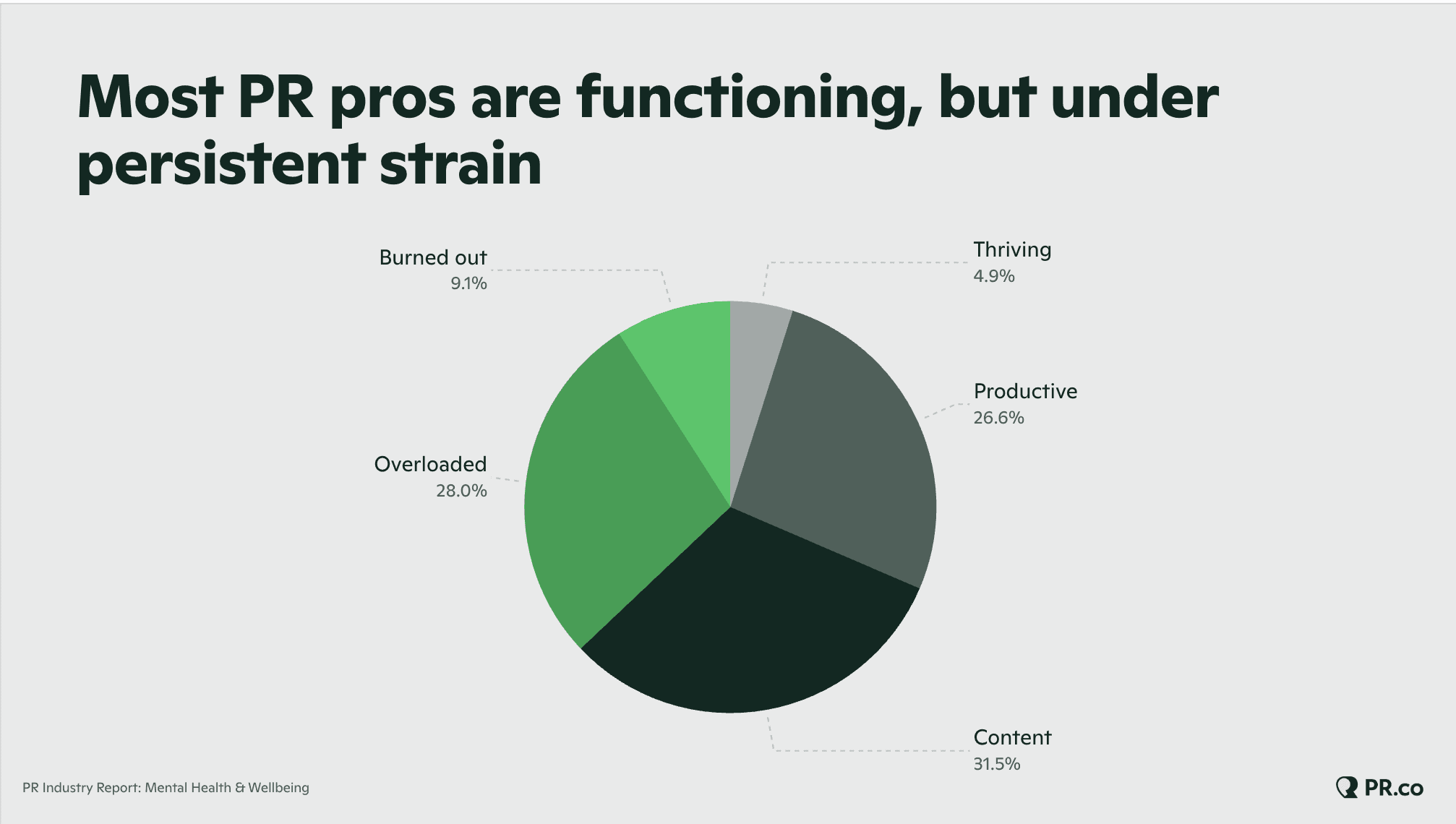
While very few professionals describe themselves as burned out, the early-stage indicators are widespread and hard to ignore:
Nearly 37% of PR pros are operating under pressure.
About 60% of respondents feel overwhelmed daily or multiple times a week.
51% cite limited time for strategic thinking as their single biggest source of stress.
Freelancers and agency professionals report the highest daily overwhelm rate at 25.8% (about double that of in-house peers).
This gap between “only 9% burnt out” and “60% frequently stressed” reveals a critical pressure zone inside PR teams. Statistically, most respondents didn’t report active burnout, but many are currently working in conditions that may increase the likelihood of burnout.
In practical terms, PR professionals are managing to keep all the balls in the air, but often at the cost of recovery and their baseline well-being.
And when more than half the workforce is running on fumes, it doesn’t take much to push stress into genuine burnout territory. A misaligned launch, an unexpected crisis or a week of reactive requests might very well push team members over the edge.
Want the complete insights and data? Download the full PR report now.
What drives overload: volume or volatility?
So what’s really behind all this stress? Our research shows it’s not just the sheer volume of work PR teams juggle, the long hours or less-than-optimal budgets, but also the unpredictability of the work.
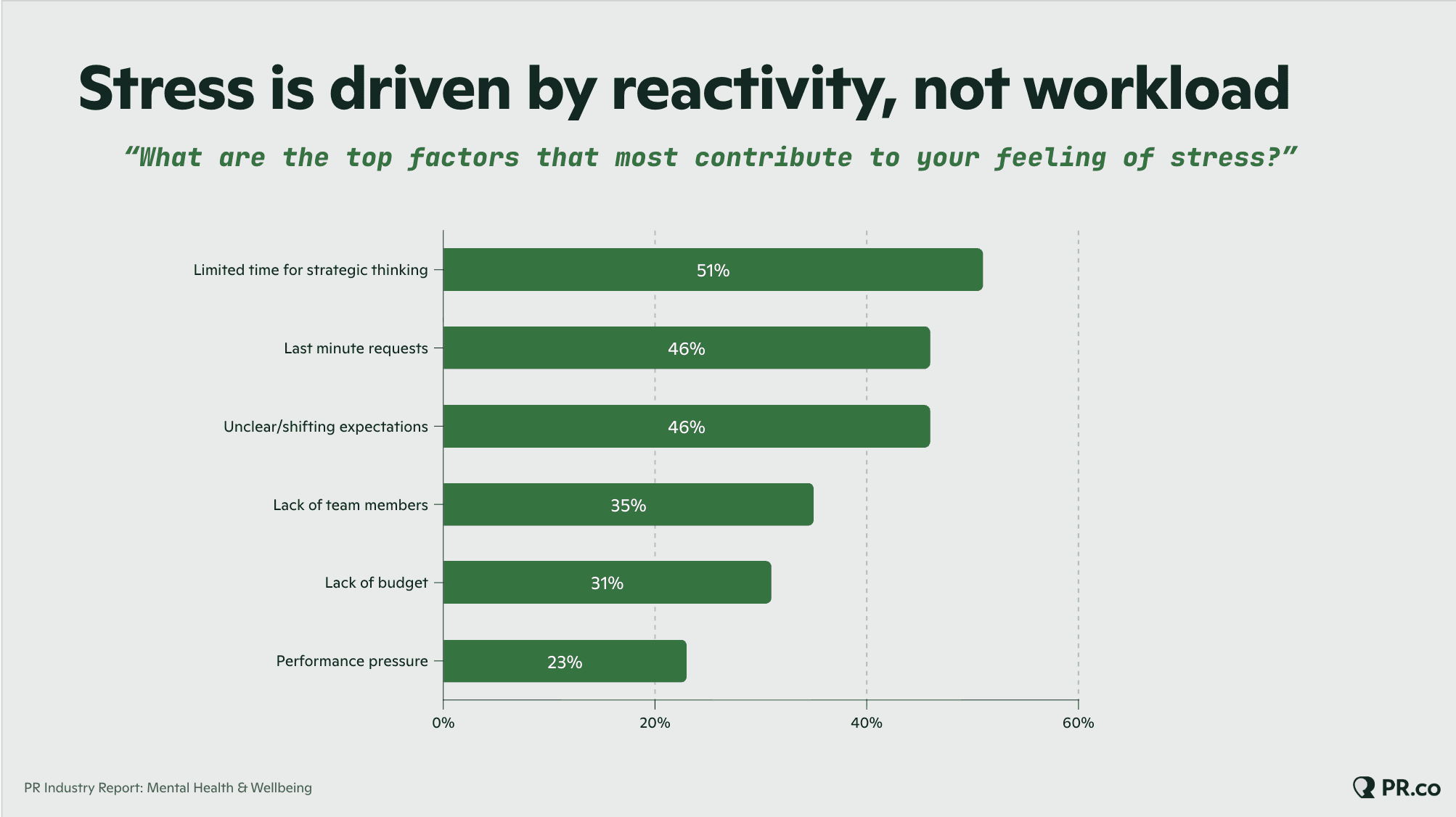
Task volume actually ranks fairly low as a stress driver. What weighs heavier is volatility: shifting priorities, sudden urgent requests and constant interruptions. The issue isn’t “too much work.” It’s the way the work keeps getting disrupted.
The biggest stressor across the industry is the lack of time for strategic work (more than half of respondents identified this as their top stressor). Deep, high‑value thinking is constantly pushed aside for last‑minute tasks, reactive requests and immediate fires that need putting out.
Unclear expectations and a steady stream of “can we do this today?” requests from leadership or clients only add to the pressure. When the PR professional’s workflow is reactive by default, even the best time‑management habits become ineffective.
“We already know the workload in PR is intense,” notes Brandi Sims, CEO and Founder of Brandinc PR. “It’s consistently ranked among the most stressful careers because of the constant demands and high expectations. But how the work is structured absolutely plays a major role in burnout.”
An ‘always‑on’ environment: boost or burnout?
One of the most interesting (and honestly, most complicated) findings from the survey centers around availability. The data reveals an “always‑on paradox” that challenges the usual assumptions about work-life balance in PR.
On one hand, being available after hours actually boosts how productive and connected many PR professionals feel. When they stay plugged in, they feel looped into key conversations, involved in decision-making and generally more in control of their work. High availability creates a sense of relevance and influence.
But here’s the twist: constant availability is also linked to higher levels of burnout and exhaustion. And this is where the paradox comes into play. The always‑on culture fuels a sense of importance and momentum, but it also chips away at important recovery time.
When boundaries between work and personal time aren’t clear, and priorities shift constantly, it becomes impossible for PR pros to truly disconnect from work outside office hours. The battery keeps outputting energy, but there’s never a scheduled moment to recharge.
Thirteen percent of respondents reported that their time and boundaries weren’t respected. It was also interesting to note that agency professionals faced the most boundary challenges.
“When I worked for an agency before I went out on my own, it was this kind of situation all day, every day,” says Michelle Garret of Garret Public Relations. “It was untenable. I would go home after working a 12-hour day and be so wound up that it was hard to relax. Then, I had to turn right around and do it again the next day.”
Ready to dive deeper into the data? Get the full PR report now.
Why does PR leadership culture matter more than company size?
As we unpacked the real sources of PR burnout in today’s environment, we looked at whether company size was a factor.
Large global agencies are often seen as high-pressure environments, while smaller boutique firms or compact in‑house teams are assumed to offer more balance. The survey data tells a different story.
Factors such as team size, organizational scale and even total hours worked had far less influence on well-being than leadership culture. The strongest predictors of positive PR mental health were clear leadership communication and a genuine sense of appreciation. These elements outweighed structural factors such as company size and headcount.
A lack of appreciation from leadership emerged as one of the most significant stressors in the industry. A concerning 22.4% of respondents felt misunderstood or undervalued by their management team. And in-house teams were nearly 60% more likely than agency staff to feel that leadership didn’t understand or appreciate their work.
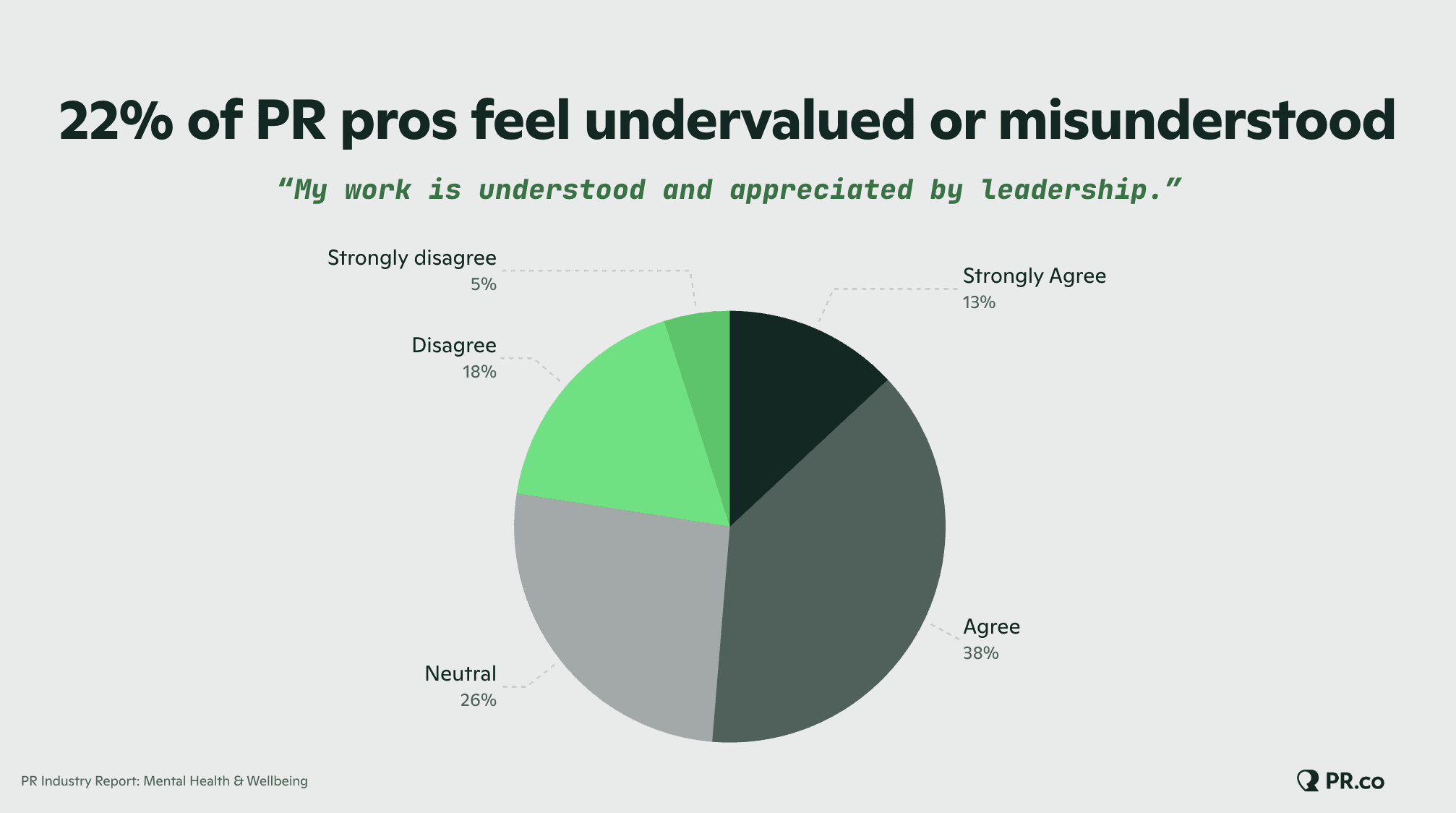
The reality is that PR teams often operate behind the scenes. In fact, our research showed that one in three PR pros are frequently or always expected to work beyond standard hours. Many manage crises, shape narratives and handle sensitive communications that aren’t always visible inside or outside their teams.
When this work goes unrecognized at the executive level, it can quickly lead to frustration and disengagement. And so, the difference isn’t company size. It’s PR culture.
Sims notes that it helps to set clear boundaries and do calendar blocking. “That shift was a game-changer for me early in my entrepreneurial journey.”
When she started building her PR company, Brandinc PR, Sims defaulted to her agency training. She tried to always be available and responsive, no matter the hour.
“I remember one night responding to last-minute press release edits while my husband literally had to point out the time. That moment forced me to pause and ask myself what this was costing me: my health, my peace, my sanity. Burnout eventually hit, and that became my turning point.”
What are public relations professionals actually asking for?
What the PR professionals we surveyed want from their work environment is, at its core, remarkably straightforward. They don’t want the industry to slow down or for crisis communications to disappear. They understand the realities of the field they chose.
What they want is operational maturity. They want dedicated, protected time for strategic thinking, i.e., time that isn’t constantly interrupted by last‑minute requests.
These pros ask for fewer “urgent” tasks that could have easily been planned well in advance. They want clearer expectations from leadership, better documentation and resourcing that actually matches the scope of the campaigns they’re responsible for.
In short, today’s PR pros want to be treated like the strategic partners they are, not like on‑demand rapid‑response units.
Once again, Sims has advice: “Good leadership in PR today means investing in your team’s growth, not just their output. […] It means sharing insights, opening doors and helping emerging professionals navigate today’s rapidly changing media environment with confidence.”
Garrett adds, “Good leadership models the behavior that should be part of the culture. For example, a good leader won’t email after hours or on the weekend because they understand not to interrupt the team members’ personal time (unless it’s a true emergency).”
How can better workflows prevent PR burnout?
Our research indicates that the solution to PR burnout lies less in personal coping mechanisms and more in improving the operational environments in which these professionals work. No amount of meditation, yoga or time‑management hacks can compensate for a fundamentally broken structure or workflow.
This is where stronger operational foundations can make a real difference. Apart from good leadership, we believe PR teams also need tools and processes that create visibility, structure and predictability. When priorities, timelines and responsibilities are clearly mapped, teams can plan work proactively rather than react to it.
Sims agrees that structure is important: “Within our agency, we’ve been intentional about building systems that maximize efficiency using AI tools, clear processes and realistic timelines to help protect deadlines and reduce unnecessary pressure. That helps, but it doesn’t completely eliminate burnout.”
While it certainly isn’t the only structural change required for PR teams to cope better, a dedicated collaboration platform like PR.co can help build healthier patterns. PR.co gives PR teams a single solution to manage tasks, streamline communication and protect time for high‑value thinking. When workflows improve, productivity rises, stress levels fall and the path toward sustainable work becomes much clearer.
Curious how your team could get more done in less time, without the stress that comes with chaotic workflows? Then, schedule a PR.co demo.
How the PR burnout data was collected
This PR.co data is based on a global survey of 143 PR and communications professionals conducted in Q4 2025.
The group spanned in-house teams, agencies and freelance roles across various industries and organization sizes. Respondents represented multiple seniority levels, from specialists to executive leadership, with participants primarily located in North America and Europe.
The goal was to move beyond assumptions about stress and burnout and understand the structural realities that currently shape the PR industry.
If you'd like to dive into the data, download the free PR report here.
FAQs
Is PR burnout mostly caused by working too many hours?
No. Hours matter, but our research shows PR burnout is driven more by how work is structured. Reactive workflows, unpredictable requests and little protected time for strategy can all lead to exhaustion, stress and burnout.
What’s the “always‑on” paradox in PR?
After‑hours availability makes PR professionals feel informed and productive, yet it also increases exhaustion and puts them at risk for burnout. Engagement rises, but recovery becomes much harder.
How can PR leadership reduce team stress?
Our study suggests that to improve PR team productivity and PR workload management, leadership should set firm after‑hours boundaries and help implement clear workflows that limit last-minute requests. It’s also key to protect creative, strategic time and acknowledge behind-the-scenes work.
Gepubliceerd
Bijgewerkt op
Geschreven door
Beoordeeld door

Genoten van het artikel?
Ontvang de beste nieuwsbrief voor Nederlandse pr-professionals
Ontvang expertinzichten over PR, communicatie en AI in je inbox.