
TL;DR: Fragmented, “duct-tape” PR easily breaks global brand consistency as organizations scale, driving rework, costs and lost trust. This article explains why brand fragmentation happens, its impact on SEO and GEO, and how “brand enabling” helps you scale with control. It also includes a free audit.
Key insights:
Global expansion breaks brand consistency faster than most teams anticipate, often by market 3–5.
Fragmented brand consistency hurts trust, increases costs and weakens SEO/GEO authority.
Most brands fail by choosing between central control and local autonomy instead of designing the PR workflow for both.
A patchwork, “duct-tape” PR approach forces every market to recreate assets, which wastes resources.
Global brand consistency is a growth lever: A single, strong narrative strengthens visibility across media outlets, social media, search engines and AI systems.
The solution isn’t tighter control. It’s “brand enabling.” This includes shared infrastructure with clear global guardrails and real local flexibility.
Most globally expanding brands hit a consistency breaking point, usually between the third and fifth market launch. One day, the public narrative is unified. Next, the logo is slightly off in one region, and the tone reads like a textbook translation in another.
These situations usually indicate that the company’s expansion has outpaced its PR structure. In a small company, communications are simple. But once you add five markets, three languages and dozens of spokespeople, things quickly become chaotic.
If you don’t manage this with the right infrastructure and software, you end up with a scenario we like to call “duct-tape” PR, a major obstacle to effective global branding. You spend millions building a global brand, but to a journalist, influencer or investor, you look like eight different companies awkwardly stuck together with duct tape and good intentions.
Why does global branding start to crack?
Typically, the battle for global brand consistency doesn’t start with the first or second international market. It usually begins when a new decision-maker or team enters the picture, or when the brand expands to two or three more markets. New team members might not be familiar with the brand’s original intent or have easy access to up-to-date brand guidelines and start making calls based on assumptions rather than insights.
It gets even more complex when brands need to build a local brand strategy to resonate with local target audiences while maintaining global brand consistency. When entering a new region, teams often feel pressure to make a strong impression. As a result, they lead with noise and disruption rather than with a clear understanding of the brand and how to communicate the narrative effectively in the new market.
The framing of “central” versus “local” is also where most global PR strategies go wrong, says Magdaleen Scott, a 25-year PR veteran and founder of KVD Communications, and, more recently, MS Consulting.
“The right model is built around a strong center and genuine local authority. The center defines what’s non-negotiable: the brand’s values, its core brand identity, logo usage, brand voice and its key messages,” she explains.
“Local teams then have genuine authority (not token authority) over how those elements are expressed in their markets. They’re not adopting a global strategy. They’re building a local strategy that’s coherent with the global brand.”
Localization requires adapting messaging, tone, context, brand voice and social media to fit the market. But without clear guardrails, the risk for brand drift is high, weakening brand recognition across markets. It also undermines long-term global branding efforts. Instead of refining the message for local relevance, teams reshape it entirely. Over time, this hurts brand recognition and trust.
What’s the real cost of fragmented communications?
Brand fragmentation doesn’t just make it harder to build brand awareness and brand recognition in new markets. When communication teams work in silos, it also drives up costs.
Three primary costs are linked to fragmented communications:
The localization rework tax: “When your base assets are inconsistent, every market starts from scratch,” Scott says. “You’re not localizing, you’re recreating. That cost compounds across every market, every campaign, every quarter.”
SEO and GEO erosion: Brands no longer write only for journalists, investors and customers, but also for search engines, Large Language Models (LLMs) and AI tools. Generative Engine Optimization (GEO) rewards consistency and authority.
Scott explains that a brand that shares fragmented messages or speaks in different tones across multiple markets dilutes its authority rather than building it.
“PR has always had the power to build the kind of earned, authoritative presence that search engines reward,” she says. “In the AI era, that power is amplified enormously, but only if the brand’s communications infrastructure is coherent enough to be indexed as a unified entity.”
Lower search rankings, fewer citations in AI answers and less organic traffic all have a direct impact on the business’s bottom line.
The speed vs. control paradox: Many PR leaders feel forced to choose between control and speed. If they prioritize global brand consistency, they’re stuck waiting days for IT to update a legacy system. If they prioritize speed, local teams might publish materials that don’t fully align with the core narrative.
Both scenarios are costly. Waiting days for IT or approvals means PR teams miss key news moments, journalists move on and opportunities for coverage or engagement are lost. When teams prioritize speed, inconsistent messaging, duplicated work and eventual, time-consuming cleanup inevitably follow (to align with the global brand identity and narrative).
Brand enabling is your new infrastructure
Moving from reactive PR to “brand enabling” is how global brands maintain consistency as they grow.
Scott believes “brand enabling” is built around a single, accessible, well-governed repository of assets or a digital asset management that includes brand guidelines that regional teams can access and adapt within defined parameters.
This doesn’t involve HQ checking every comma. It involves giving local teams genuine authority over their regional PR strategy and how the brand shows up in their respective markets. The center defines what’s non-negotiable, including core visual brand identity and brand values, while local teams drive how the strategy is applied in their local context.
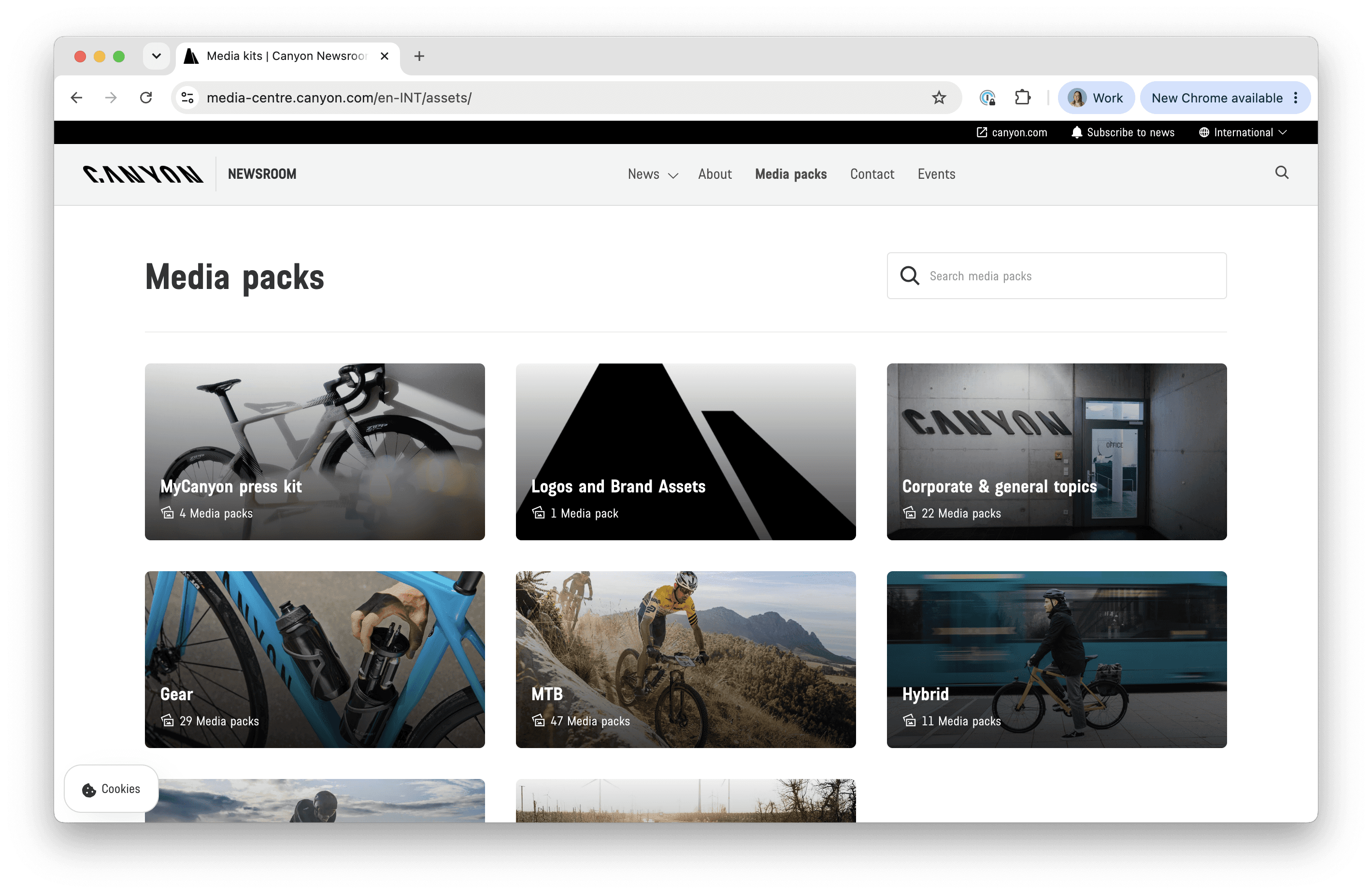
Here is how the cycling brand, Canyon, displays their media packs in their online newsroom:
Scott offers practical advice: “Pull the last three months of assets produced across every region you operate in. Every press release, every social post, every campaign visual. Put them side by side and look at them as a consumer would.”
Then, use the audit framework below (👇) to assess your fragmentation score. If this audit reveals inconsistencies (and it usually does), the answer is better infrastructure.
Stop paying the inconsistency tax
Most PR teams still operate across disconnected tools and systems, which is exactly how “duct-tape” PR happens.
In our experience, there’s only one way to win at “brand enabling.” International and multi-brand PR teams need one central hub with clear guardrails, shared assets, centralized PR workflows and real visibility. In other words, a setup that lets all team members stay aligned on a single brand narrative while also giving local teams the freedom to adapt.
That’s exactly what PR.co was built for. We help communications leaders in large organizations keep brand communication consistent across markets, without slowing local teams down or creating chaos.
Could this be the solution your PR team needs? Schedule a demo with Nelson to learn more.
Free audit: What’s your fragmentation score?
As your company expands across markets, maintaining a consistent brand becomes increasingly difficult.
Take our 2-minute assessment to help you identify where fragmented PR processes may be costing you time, visibility, and trust.
FAQs
1. How do we move from a “duct-tape” setup to a centralized system without a coordination nightmare?
Build infrastructure that manages brand assets from a single hub, accessible to all team members. By providing local teams with a clear structure, you ensure everyone works from the same PR strategy from day one.
2. Can AI help audit brand consistency across our different markets?
Yes. In 2026, AI is a practical tool for maintaining brand coherence. Scott notes that AI can currently audit thousands of assets in the time it takes a human to review ten. AI can flag deviations and suggest localization approaches.
3. What’s the difference between “brand policing” and “brand enabling”?
Brand policing focuses on restriction. Scott says that “brand enabling” is about building infrastructure, like a well-governed repository of assets, that makes local teams more effective within defined parameters.
4. Does brand consistency affect SEO and AI search?
Yes. Fragmented messaging dilutes brand authority. A unified, PR.co-powered newsroom, for example, helps search engines and AI models index your brand as a single, authoritative entity.
Published
Last updated
Written by
Reviewed by

Subscribe to our newsletter
Stay ahead in PR & comms
Get expert insights on PR, communications, and AI delivered to your inbox.