

TL;DR: When a crisis hits, guesswork costs you. Crisis stakeholder mapping gives you a logic-led plan to stay in control and avoid chaos. When you prioritize who needs to hear what and when, teams can act faster, align internally and protect reputation under pressure.
Key takeaways:
Crises are inevitable. A structured plan can help keep your response controlled instead of chaotic.
Information overload can paralyze decision-making in a crisis, leading to costly delays and mistakes.
A crisis priority matrix can help you act fast by clearly ranking who needs to know what and when.
Stakeholder mapping ensures consistent, targeted communication across all key audiences.
Internal communication is critical. Well-informed employees often protect and reinforce your message.
Clear leadership and alignment keep teams coordinated, compliant and focused under pressure.
Most organizations are touched by a crisis at some point. In fact, PWC’s 2023 Global Crisis and Resilience Survey revealed that, on average, organizations experienced three-and-a-half disruptions in the previous two years.
This highlights just how common these high-pressure situations have become. While you can’t predict when a crisis will hit, you can control how prepared you are when it does.
The difference between a controlled response and a chaotic one is planning and structure.
This guide introduces the priority matrix: a logic-based system that helps to ensure your most critical stakeholders are reached in the right order.
What’s the cost of information paralysis?
Adults make, on average, 35,000 decisions a day. When a crisis hits, that number may quickly increase. Without a clear framework to guide decisions, leadership teams may quickly fall into “information paralysis,” a state in which the volume of incoming data overwhelms their ability to interpret it and act.
This isn’t just an operational inconvenience. It’s a business risk. While 93% of leaders acknowledge that their decision-making can make or break their organizations, many still struggle to act under pressure.
Unfortunately, poor or delayed decision-making costs brands not just their reputation (as shown in these “worst PR disaster” examples), but also, in many cases, their profit share.
Take Jaguar Land Rover as an example. In 2025, following a cyberattack, the company was forced to shut down its computer systems, which affected its production line. Navigating a crisis of this scale led to delayed decisions, which arguably contributed to the £485 million loss and 24% drop in revenue JLR suffered.
Hesitation during a crisis often creates a vacuum that can be filled by media speculation or misinformation spread on social media. This is where structure and speed become essential.
According to Payal Patel,a strategic communications leader and crisis management expert, effective crisis communications is not about having every answer, it's about communicating early with honesty.
"The biggest risk of going public too early is sharing incomplete or inaccurate information that damages credibility. The risk of waiting too long is creating an information vacuum where speculation fills the gap. Organizations should communicate early with honesty, acknowledge what is known, what is still being assessed, and when stakeholders can expect the next update."
A crisis priority matrix helps businesses cope with crises by ranking stakeholders by urgency. Instead of being paralyzed by information, teams then know exactly who to contact when to ensure the crisis doesn’t get out of hand.
How to define your crisis priority matrix
A strong crisis communications plan starts with clear ownership. When decision-makers are clearly defined, PR teams can be proactive rather than reactive under pressure. They’re better equipped to make informed decisions and respond quickly and with confidence.
Think of your crisis priority matrix as your organization’s GPS. In moments of uncertainty, it helps you to navigate toward the right response with speed and clarity.
At its core, it’s a planning tool that establishes a clear chain of command, mapping out who leads, who makes decisions and who is responsible for communication.
But a crisis priority matrix on its own isn’t enough. To respond to a crisis effectively, you also need to be clear on who needs to hear from you and when.
How to do crisis stakeholder mapping
Stakeholder mapping makes it significantly easier to identify who PR teams need to communicate with and the most effective way to reach them during a crisis.
This is especially important for enterprise organizations that operate across multiple regions, where different audiences may have different expectations and communication needs. Stakeholder mapping becomes exponentially harder as organizations scale across markets, regulatory environments and stakeholder groups. What works for a single-market team breaks down quickly at enterprise level.
The first step is to map all relevant stakeholder groups, from internal teams and senior leadership to shareholders, investors and the media. The next step is to build out a clear plan for how each group should be managed.
Patel notes that stakeholder communication should be driven by impact, not hierarchy. "The first question should always be: who is most directly affected, and who needs information immediately to make decisions, stay safe, or maintain trust? That often means employees first, followed closely by customers/patrons, partners, regulators, and investors, before the media and other public stakeholders," says Patel.
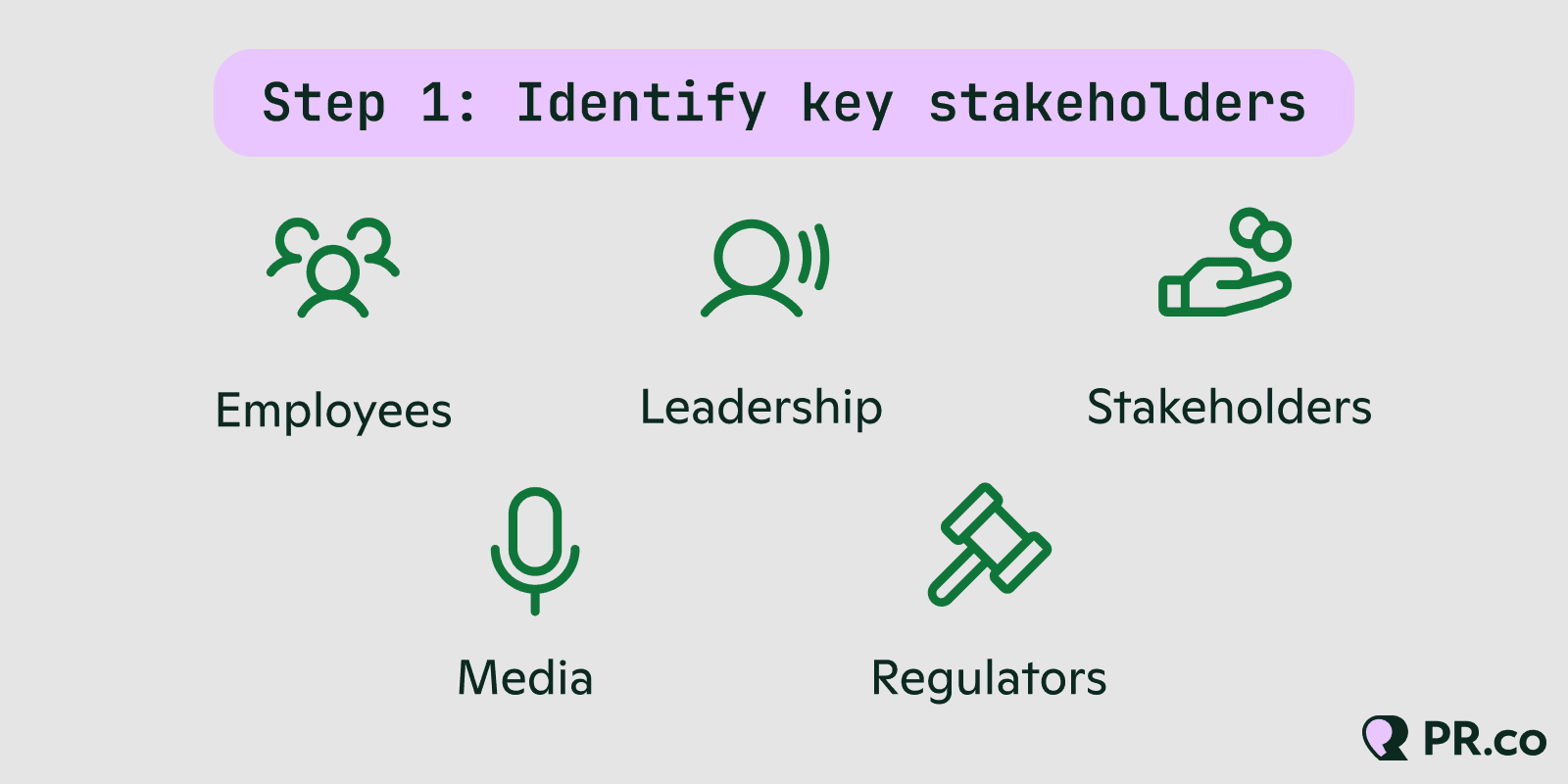
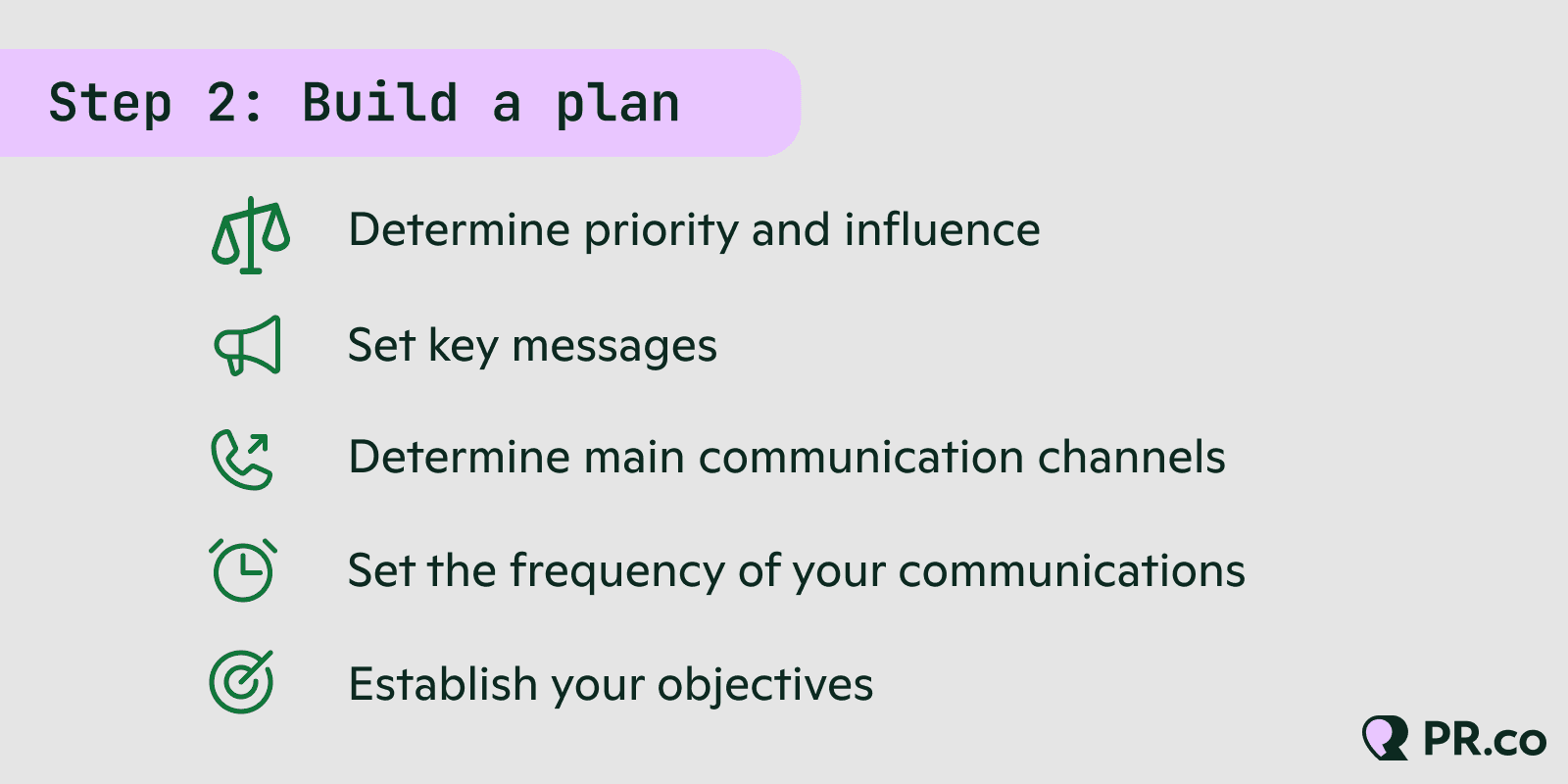
To create an effective crisis stakeholder map, you need to define:
Priority level and influence: How critical is each stakeholder group to your response?
Preferred communication channel: Are they best reached by email, phone, internal platform or press release?
Frequency of updates: Do they need to be updated in real time, daily or only as key developments happen?
Key messages: What information do they need to know?
Objective: What do you want to achieve with your communication? Is it designed to inform, reassure or simply instruct?
When all of these elements are mapped out in advance, it allows you to move with the speed the crisis situation demands and maintain message consistency (a critical part of remaining in control).
Why most stakeholder mapping fails in real crises
Without a system behind it, many stakeholder mapping documents fail when needed most. Not because of the content, but because it was never operationalized.
In many organizations, if it exists, it usually lives as a static document, an outdated spreadsheet disconnected from real workflows. Under pressure, teams ignore it or can’t rely on it.
Ownership is often unclear, creating decision bottlenecks and slowing approvals. At the same time, messaging and resources are scattered, leading to inconsistent or outdated communication.
The result: what should guide decisions becomes irrelevant. Without a system behind it, a stakeholder map is just a document, not a tool for action.
Internal communications vs investor relations: Who should know first?
Employees and investors play distinct yet equally important roles in driving business success. Employees are your most powerful ambassadors. They shape how your organization is perceived from the inside out. Investors, meanwhile, fuel growth and provide the financial confidence needed to sustain and scale your organization.
In times of crisis, however, companies often prioritize external messaging and overlook their internal communications. However, keeping employees informed is essential to maintain your external narrative and prevent misinformation from spreading.
"Internal teams should never learn about a crisis from the news; they need clarity early so they can respond confidently and consistently," says Patel.
When employees understand what’s happening, they can reinforce and amplify your message rather than unintentionally undermine it. That’s why a clear internal communications hierarchy is a cornerstone of effective crisis management.
For global enterprises, this challenge is often more complex. Different regions, time zones and stakeholder needs require a well-coordinated approach. A crisis priority matrix, supported by a software platform like PR.co, makes it easier to achieve seamless collaboration and distribute regular, consistent updates.
Investor relations demand an equally disciplined approach during a crisis.
Investors need context, reassurance and a forward-looking perspective to maintain trust and confidence in your business when things go wrong, which becomes more challenging with a diverse investor base.
At PR.co, we’ve created our investor hub feature for good reason. It serves as a single source of truth for sharing critical announcements, interactive reports and any other information to support transparent, timely communication when you need it most.
Why internal alignment is the key to crisis survival
A 2024 Ipsos Reputational Council report highlights that finding the right balance between global consistency and local flexibility remains a key challenge for communications teams, particularly in times of crisis.
This balance goes beyond reputation. It’s also critical for managing compliance risk. In regulated industries, especially, crisis communications must meet strict legal and governance requirements. Messaging must be accurate, approved and compliant with local regulations. Get it wrong, and you could easily lose trust, damage your reputation and even incur significant fines.
Achieving this balance starts from within the organization. To navigate a crisis effectively, everyone needs to work from the same crisis communications playbook. Clear, timely communication helps prevent rumors from spreading and keeps teams focused when it matters most.
"Consistency under pressure comes from preparation," Patel explains. "Organizations need clear message frameworks, defined spokespersons, and scenario planning in place before a crisis happens. I’ve seen delayed or misaligned communication create far greater reputational harm than the original issue itself, particularly when stakeholders feel they were the last to know. Trust is often lost less because of the crisis, and more because of how the response made people feel."
To put this into practice, every effective crisis communications plan also needs a clear leader. Someone at the helm, who manages the crisis priority matrix and stakeholder communications to streamline decision-making and keep teams united around a single, coherent narrative.
Get crisis communications right, with PR.co
As organizations grow across markets, languages and product lines, narrative control becomes harder to maintain. This is especially true during crisis times.
PR.co acts as the operational layer behind your crisis communications, the kind of role dedicated crisis communication software is built for, centralizing stakeholder messaging, aligning teams across markets and ensuring every update is consistent, approved and trackable.
PR.co acts as the operational layer behind your crisis communications, centralizing stakeholder messaging, aligning teams across markets and ensuring every update is consistent, approved and trackable.
Keen to see what our software can do for you? Schedule a demo today.
FAQs
1. What is a priority matrix in crisis communications?
A priority matrix is a structured framework that helps organizations identify and rank stakeholders based on urgency and impact. It ensures the right people, from employees and investors to the media, are informed in the correct order to support a more controlled and effective crisis response.
2. Why is internal communication so important during a crisis?
Keeping employees informed during a crisis reinforces trust and reduces the risk of misinformation and rumors spreading internally and outside of the organization. When teams understand the situation, they are more likely to support and reinforce the external messaging.
3. How can businesses manage communication across global teams during a crisis?
Global organizations can manage crisis communications more effectively by using a clear priority matrix, centralized messaging and collaborative tools like PR.co. This helps ensure consistent updates are shared across regions, time zones and stakeholder groups without delays or misalignment.
Published
Last updated
Written by
Reviewed by
Subscribe to our newsletter
Stay ahead in PR & comms
Get expert insights on PR, communications, and AI delivered to your inbox.