
Jul 1, 2026

TL;DR: A crisis isn’t a matter of “if,” but “when.” Is your PR team ready? A solid audit and plan can make all the difference. Here, we share a practical crisis communications audit framework to help you create a comms plan that’s complete, clear and ready to use when it counts.
Key insights:
Crises are inevitable. Often, outcomes depend more on the communication response than the event itself.
Most crisis plans fail in practice because they aren’t clear, practical or tested under pressure.
Defining clear decision-making authority up front is critical to avoiding delays and confusion.
Effective crisis communication requires multiple channels and tailored messaging for different stakeholders.
It’s critical to test workflows and run realistic simulations to ensure the team can act quickly and confidently.
Continuous post-crisis review is essential to improve and avoid repeating the same mistakes.
At some point, every business faces a crisis. In those moments, the outcome is often shaped less by the crisis itself and more by how the organization responds. The ability to contain the situation can be the difference between a temporary setback and lasting brand damage.
For example, when the YMCA of Greater Pittsburgh entered Chapter 11 bankruptcy in 2018, a structured crisis communications plan helped the organization coordinate stakeholder communications, maintain message consistency and protect its reputation.
According to crisis communications expert Paul Furiga, whose agency managed the “extremely sensitive” communications response, the situation involved a high-profile landlord and a fiercely loyal membership base.
Despite the stakes, the organization emerged with virtually no reputational damage – all thanks to good planning. “Today, the YMCA is in strong financial health and well-poised for growth,” Paul says.
Most organizations already have a crisis comms plan in place. Unfortunately, when things go wrong, those plans often don’t hold up under pressure (as evidenced by our “Worst PR Disasters” list).
An effective approach goes beyond a document that sits in a folder on a drive. It’s built on systems, habits and a few key pillars that make for fast, coordinated and confident action when the unexpected happens.
The 5 pillars of a crisis communications plan
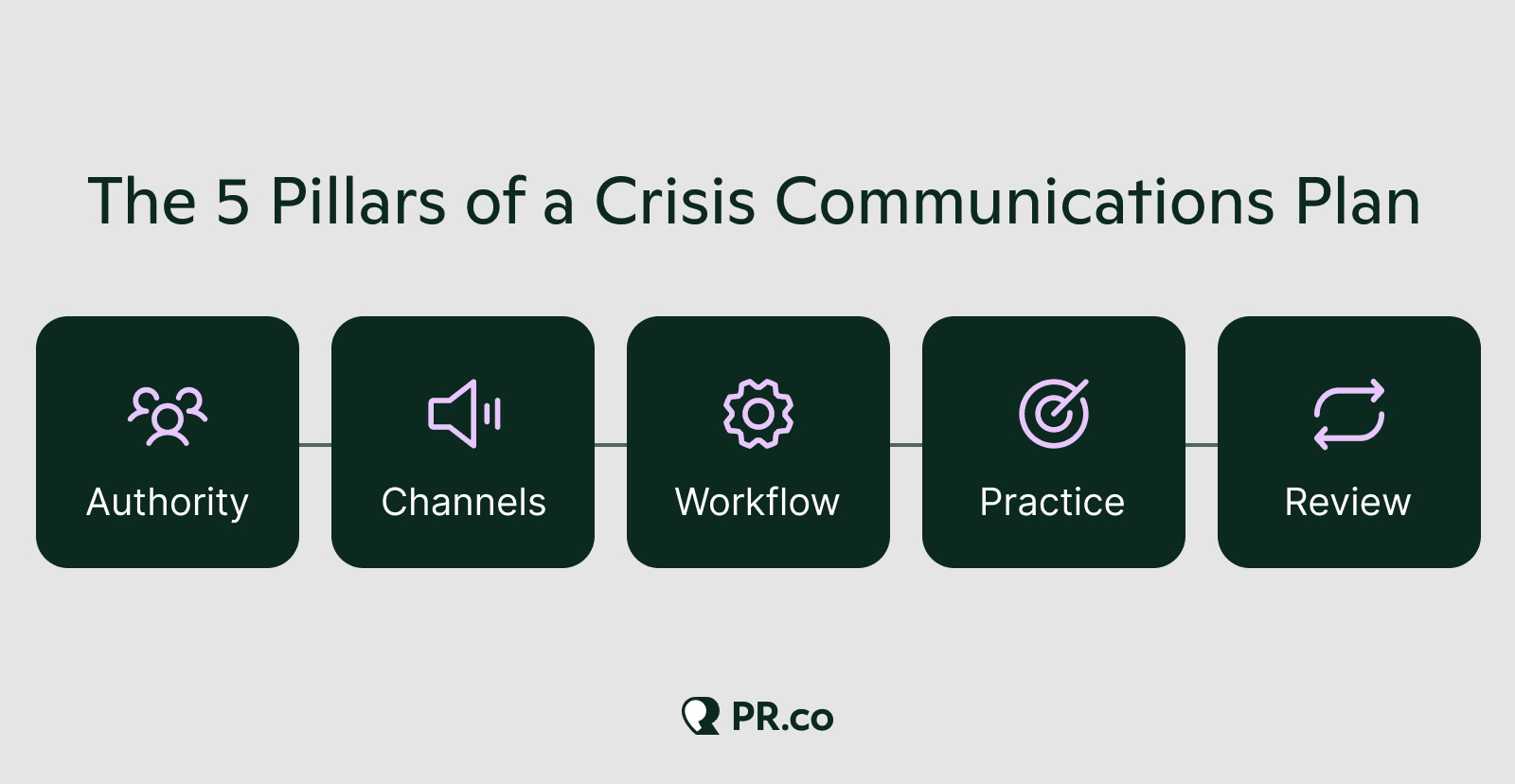
In this article, we unpack five key pillars you need to keep in mind when you set up a crisis communications plan:
Map out the truth holders. Decide who has the authority to make decisions.
Plan multiple communication channels. Identify ways to reach employees, the media, investors and other stakeholders.
Test your workflow. Make sure everyone understands the steps to follow in a crisis.
Practice realistic scenarios through simulations or drills. Make sure everyone is prepared for specific eventualities.
Review and improve after every incident. Review the crisis and determine how you can improve your response process.
Let’s look at each of these in more detail.
1. Map out the truth holders: Who has the authority to make decisions during a PR crisis?
A crisis communications plan can fall short when it’s unclear who has the authority to make decisions.
In most organizations, final accountability rests with executive leadership. A crisis communications team, including a spokesperson, a communications lead and legal counsel, typically plays a supportive role in large enterprises.
One of the keys to a successful PR crisis response is to define these roles upfront and ensure they’re understood throughout the organization. Stakeholder mapping (refer to our guide here) helps identify who PR teams need to communicate with and the most effective way to reach them during a crisis.
Just as important is identifying who needs to hear what, and when. Paul recommends creating a stakeholder communication cascade before a crisis occurs.
During the YMCA bankruptcy scenario, for example, communications were carefully sequenced from board members to employees to donors and, finally, to the public. This ensured that no key audience felt blindsided and reduced the risk of conflicting narratives emerging.
What can go wrong when decision-making authority is unclear in a crisis?
Decisions slow down because no one clearly owns them.
Regional teams act independently, which leads to mixed messages across markets and languages.
Some teams wait too long for approval, while others act without alignment.
Leaders get pulled into day-to-day decisions, creating bottlenecks.
2. Plan multiple communication channels: Where will you communicate during a crisis?
Different audiences (e.g., employees, external stakeholders, customers, the media) typically engage on different channels.
In many tricky PR scenarios, existing platforms will suffice: internal town halls and employee apps, emails, social media, your corporate website and your online newsroom, for example.
However, fast-moving crisis situations may require additional reach. It could work to use wire services, press briefings or media interviews to ensure timely, broad visibility. (For a useful guide to communicating with the media, read our Media Relations guide.)
Equally important is tailoring the message to the audience. While channels and audiences may vary, the core story should remain consistent.
One effective way to achieve this is through a message pyramid: a framework that defines the central message and supporting points that should appear across every communication.
Paul credits this approach as a critical factor in the Pittsburgh YMCA’s response. The same message pyramid guided everything from the CEO’s press conference remarks and member communications to website updates and media outreach.
“Inconsistency is what turns a manageable crisis into a reputational catastrophe,” he notes. “You can’t make this up as you go along, and far too many organizations try to do just that.”
What can go wrong if your team isn’t set up properly before a crisis hits?
Senior leadership may be pulled into communications rather than focusing on resolving the issue.
Lack of internal alignment can lead to incorrect, delayed or inconsistent information being shared (or not shared at all) on social media.
An untrained or unprepared spokesperson may misrepresent the brand, causing further damage.
Conflicting messages and visible uncertainty could hurt consumer, employee and stakeholder trust.
3. Test your workflow: What steps should be followed during a crisis?
Sometimes a crisis can be predicted, and the way forward can be communicated in advance.
At other times, it unfolds quickly and without warning. In these moments, most PR teams don’t have time to interpret complicated response matrices and debate next steps.
Many crisis communications plans break down at this point. The steps may exist on paper, but they haven’t been properly tested or implemented across the organization.
This is where testing your workflow becomes critical. Now’s the time to run short, realistic simulations (e.g., a breaking news scenario or a social media escalation) to see if the team can identify the issue, assign ownership, approve messaging and publish a response under time pressure.
A tool like PR.co helps to streamline this workflow. Think faster coordination, transparent approvals and more seamless communication.
What can go wrong if teams don’t have the right crisis comms workflow in place?
Team members hesitate because ownership is unclear.
Regional teams respond independently, creating misalignment across countries and channels.
Leadership is brought in too late, without a clear view of what’s already been communicated.
Time is lost to coordination rather than to response.
Our Crisis Communication Plan for PR teams provides more info about the types of crises your organization may face and what to do before, during and after each one (i.e., the workflows to set in place).
4. Practice realistic scenarios through simulations or drills: Is everyone prepared for a crisis?
Once roles and workflows are clearly defined, preparation comes down to practice.
In a real crisis, people rely on what they’ve done before. Regular exercises help teams build confidence, uncover gaps and identify bottlenecks before they become problems.
Paul recommends running tabletop exercises at least annually and, for larger or more complex organizations, as often as every quarter.
These exercises walk leadership teams through realistic crisis scenarios in real time. It helps them to identify weaknesses in escalation procedures, approval chains, scenario planning and messaging before the pressure is real.
What can go wrong if organizations haven’t practiced what to do during a crisis?
Teams rely on assumptions rather than aligned processes.
Regional teams interpret guidance differently, which leads to inconsistent messaging.
Language nuances shape how messages are perceived across markets.
5. Review and improve after every incident: How can we respond better to the next crisis?
Every crisis tests your systems. What you do afterward determines whether those systems improve or whether the same issues repeat across markets, teams and regions when the next crisis hits.
Allow enough time after every PR crisis to review what happened, how it was handled and where your team can improve.
Gather input from teams and stakeholders across the organization, and from external sources where relevant. Then document those insights and apply the learnings consistently across all regions.
What can go wrong if PR teams don’t evaluate what went wrong?
The same issues recur.
Teams develop their own approaches, leading to inconsistencies across markets.
Leadership loses visibility into how crises are managed globally.
The crisis communications audit
Having the right pillars in place is only part of the equation. The real test is whether they work together in a live situation, when time is limited, information is incomplete, and pressure is high.
Use the framework below to do your crisis management audit. The idea is to check if you’ve covered all five pillars in your plan, and to identify any potential weak points.
It’s best to do a comprehensive, data-backed analysis and to create a formal report with findings, benchmarks and recommendations.
Area | Focus | Key crisis communication audit questions |
Governance & decision- making | Roles, ownership, escalation | • Who has final decision-making authority in a crisis?• What decisions can be made regionally vs. escalated to HQ?• Who has final sign-off on external communications (e.g., press releases)?• When should leadership step in, and when should they step back?• Which specific triggers require a local issue to be escalated to the regional or global level?• Who must be notified first, regardless of location? |
Stakeholders & messaging alignment | Consistency, coordination | • How do we ensure messaging is aligned before it goes live?• How is communication cascaded internally across teams and regions?• How is messaging adapted for different stakeholders (employees, media, customers)?• How do we avoid conflicting messages across regions or languages? |
Channels & spokesperson readiness | Platforms, delivery, ownership | • What internal communication platforms are available? External? • Who uses which channels, and when?• What additional channels might be needed in a fast-moving crisis?• Who are the designated spokespersons for each audience?• Are spokespersons trained and media-ready? |
Workflow & execution under pressure | Speed, clarity, first response | • What happens in the first 30–60 minutes after a crisis emerges? • Are the response steps clear and easy to follow under pressure? • Do teams understand their roles in the workflow? • How is information shared in real time across regions? • Where are potential bottlenecks in decision-making or approvals? |
Simulation & preparedness | Practice, readiness, realism | • Have we tested realistic crisis scenarios recently? • Do regional teams respond consistently in simulations? • Where do teams rely on assumptions instead of defined processes? • Are there gaps between documented plans and actual behavior? |
Review & continuous improvement | Learning, iteration, visibility | • Where did coordination break down between teams? • Did messaging remain consistent across markets and languages? • Did leadership have clear visibility throughout the crisis? • What worked well, and why? • What needs to improve before the next crisis? • How are learnings documented and shared across the organization? |
Protect your brand during a crisis with PR.co
When your brand faces a crisis, you need a way to communicate with the stakeholders that matter most, and do so quickly.
With PR.co, it’s easy to build a crisis newsroom for moments when your news updates have to be delivered fast and to the right people. Our software also simplifies team collaboration, media outreach, stakeholder approval and more.
Keen to learn more about our solution? Schedule a demo.
FAQs
1. What is a crisis communications audit?
A crisis communications audit is a structured way to assess whether your crisis plan will actually work under pressure.
It looks at how decisions are made, how information flows across teams and how to ensure messaging stays consistent across markets, channels and languages.
The goal is to identify gaps before a real crisis exposes them.
2. How often should we test our crisis plan?
At a minimum, your crisis plan should be tested once a year. For larger organizations or those operating across multiple regions, quarterly testing is often a better cadence.
Crisis communications consultant Paul Furiga recommends regular tabletop exercises to help leadership teams work through realistic crisis scenarios in real time. These exercises reveal weaknesses in approval processes, escalation procedures and messaging long before a real crisis occurs.
3. Who should be on our crisis communications team?
A crisis communications team typically includes a communications lead, a spokesperson (more on hiring the right spokesperson here) and legal counsel. Final decision-making typically rests with executive leadership.
In larger organizations, the team should also include representatives from key regions or markets to ensure alignment during a crisis.
The exact structure may vary. What matters is that you have a clear, visible plan in place. Everyone should know their role, who they report to and how decisions are made when time is limited, and the pressure is up.
4. What’s the difference between a crisis communications audit and a crisis management diagnostic?
A crisis management diagnostic is a high-level assessment that gives companies a quick snapshot of how prepared they are to handle a crisis. It includes a crisis communications gap analysis, often based on interviews, surveys or workshops.
An audit, by contrast, is a more detailed and structured evaluation. It systematically reviews processes, plans and capabilities to help teams develop a robust crisis response plan.
Published
Jul 1, 2026
Last updated
Jul 2, 2026
Written by
Reviewed by

Subscribe to our newsletter
Stay ahead in PR & comms
Get expert insights on PR, communications, and AI delivered to your inbox.