
TL;DR: Your PR analytics tools should do more than count media mentions. The right mix tracks mentions, referral traffic, backlinks, sentiment, Share of Voice and AI citations. It also connects these metrics to business outcomes. This guide compares today’s top specialist PR platforms, SEO tools and newer AI visibility options.
Key insights:
PR measurement works best when you separate campaign outputs, audience outcomes and business impact.
Specialist PR analytics tools are best for tracking coverage, sentiment and Share of Voice. SEO and AI tools answer different questions.
No single platform measures every part of PR equally well. Most teams need a combination of tools.
Advertising Value Equivalency (AVE) is popular, but flawed. Coverage quality, traffic, sentiment and conversions provide more useful evidence of impact.
AI citations are becoming part of PR measurement, but one-off prompt checks can’t replace repeatable visibility tracking.
Ask five PR teams how they measure PR campaign success, and you may get five different answers.
That’s partly because the right metrics depend on the job. A brand-awareness campaign may track reach, sentiment and Share of Voice (SOV). A digital PR campaign built around search visibility may be more about authoritative coverage, backlinks and referral traffic.
The harder question is whether those numbers show that anything useful happened.
PR analytics tools can track coverage, monitor conversations and build detailed dashboards. The best ones also help teams connect PR activity to audience behavior, reputation and business outcomes.
This guide explains which digital PR metrics matter, how to avoid misleading measures and which tools are best for different parts of the job.
What are PR analytics tools?
PR tools are platforms used to measure, analyze and report on public relations activity. Depending on the product, they may track media coverage, backlinks, referral traffic, SOV, sentiment, audience reach, campaign performance or AI citations.
Some are built specifically for PR monitoring and coverage reporting. Others focus on PR SEO, web analytics or generative engine optimization (GEO).
Most teams will need more than one tool because no single platform measures every part of PR equally well.
The top PR analytics tools (in a nutshell)
The PR analytics tools in this table all offer incredibly useful analytics features. We’ll delve into more details later.
Tool | Category | Best for | Pricing | Review rating (including no of reviews) |
CoverageBook | PR reporting | Fast, visual coverage reports | $99-$599/mo, Enterprise custom | 4.9/5 Capterra (21) |
Cision | PR monitoring | Enterprise media relations and analytics | Pricing on request | 3.8/5 Capterra (89) |
Onclusive | PR monitoring | Multi-market media intelligence | Custom/flexible pricing | 4.0/5 Capterra (3) |
Meltwater | PR monitoring | Media monitoring and social listening | Custom quote | 4.0/5 Capterra (96) |
Semrush AI PR Toolkit (formerly Prowly) | PR workflow | Media relations for smaller teams | $99/mo/domain (Base package) | Legacy Prowly 3.8/5 Capterra (19) |
Prezly | Newsroom and outreach | Publishing and campaign engagement | Essential plan: $120/month; Standard: $300/month; Enterprise: custom. | 4.7/5 Capterra (67) |
Google Search Console | Search analytics | Organic search performance | Free | 4.7/5 G2 (497) |
Ahrefs | Search analytics | Backlinks and competitor research | Lite from $119/month, Standard $229/month, Advanced $419/month. | 4.5/5 G2 (702) |
AI Peekaboo | AI visibility | GEO and AI-search visibility | Lite from $119/month, Standard $229/month, Advanced $419/month. | 4.8/5 G2 (4) |
Perplexity | AI research | Source-led research and prompt checks | Free; Pro $20/mo; Max $200/mo | 4.5/5 G2 (276) |
ChatGPT | AI research | Data analysis and brand-representation checks | Free; Plus $20/mo; Pro $200/mo; Business $25/user/ mo | 4.6/5 G2 (2,221) |
PR.co | Newsroom analytics | Publishing, outreach and campaign analytics | Custom quote | 4.6/5 G2 (41) |
Note: Ratings and pricing were checked at the time of writing and may change.
What are digital PR metrics?
Digital PR metrics are the quantitative and qualitative measures used to assess the performance and impact of your PR activities.
Quantitative metrics include media mentions, impressions, backlinks, referral traffic and click-through rates (CTRs).
Qualitative measures assess context, i.e., whether the coverage is positive, neutral or negative, how prominently the brand appears, whether key messages are included and whether the mentions reach the right audiences.
Which digital PR metrics should you track?
The right metrics depend on what the campaign is meant to achieve. Useful metrics are the ones that measure whether you are moving toward the campaign’s goals.
A thought-leadership campaign, for example, may prioritize authoritative coverage and message inclusion. A search-led campaign may focus on backlinks and referral traffic. A reputation campaign will be more focused on sentiment and SOV.
It helps to group PR measurements into three layers:
PR outputs: What did the campaign produce?
Audience outcomes: How did target audiences respond?
Business and visibility impact: What changed as a result?
Tracking all three layers helps your team avoid reporting impressive numbers without explaining why a campaign succeeded or fell short.
In the next section, we take a closer look at the metrics that matter across these layers.
PR outputs: What did the campaign produce?
Media coverage
Track both the volume and quality of coverage. Look at publication relevance, prominence, message inclusion, spokesperson quotes, links and geographic reach.
One detailed feature in a trusted industry title may be more valuable than several passing mentions on low-relevance sites.

Backlinks
Backlinks can generate referral traffic to your website or online newsroom and support search visibility, particularly when they come from relevant, reputable publications.
Track the number of links and referring domains, the quality of the linking sites, and which stories or resources earn links consistently.
Unlinked brand mentions
Podcasts, virtual events, newsletters and online articles may mention your company without linking to your website. These mentions still contribute to visibility and show whether the campaign is reaching relevant conversations.
The context is important, though. A prominent, positive mention differs greatly from a brief mention in a long list of competitors or one in a discussion about poor service delivery.
Owned-media engagement
For newsroom stories, email campaigns and media pitches, the most important metrics include open rates, CTRs, views, downloads and subscriber growth.
Read these figures together. A high CTR followed by weak landing page engagement may mean the initial message attracted attention, but the destination didn’t meet expectations.
Audience outcomes: How did target audiences respond?
Referral traffic
Referral traffic shows which placements sent visitors to your website or newsroom, and what those people did next.
Use UTM parameters (tags that track where website traffic and campaign results come from) to separate traffic by publication, story or campaign. Then track relevant actions such as downloads, newsletter sign-ups, event registrations, inquiries or purchases.
A smaller media placement may prove more valuable than a larger one if it sends the right audience to your owned channels.
Engagement time
Engagement time shows how long visitors actively interacted with a page after arriving.
Longer is not automatically better. A journalist who quickly finds a media contact or downloads an image may have done exactly what they came to do. Read engagement time alongside conversions, scroll depth and the purpose of the page.
Social media engagement
Likes, shares, comments and reposts can show whether a campaign gained attention beyond its original coverage.
The quality of that attention is critical to check, though. A story may have spread because audiences found it useful or surprising. It may also have spread because something went wrong.
Monitor recurring questions, criticism and sentiment rather than reporting the total engagement figure alone.
Sentiment analysis
Sentiment analysis shows whether coverage and public conversations were positive, negative or neutral, and whether recurring concerns emerged.
Automated tools can identify broad patterns, but they often misread sarcasm, technical language and context. Review important mentions manually before you draw any firm conclusions.
Share of Voice (SOV)
SOV compares your brand’s media presence with that of selected competitors.
Define the competitors, markets, topics and channels included before measuring it. A rising Share of Voice can signal stronger visibility. However, mention volume doesn’t equal influence. One detailed feature in a respected publication may carry more weight than several passing mentions.
Business and visibility impact: What changed as a result?
Leads and conversions
Where possible, connect referred visitors to actions such as inquiries, registrations, downloads or purchases.
PR is rarely the only influence on a conversion. Use campaign links, UTM parameters and web analytics to show contribution rather than claiming sole credit.
Branded search and organic visibility
PR coverage can prompt more people to search for your company, spokespeople or subjects linked to your PR campaign.
Monitor changes in branded search queries, organic impressions, clicks, rankings for relevant topics and traffic to campaign-related pages. Look for patterns over time rather than assuming one campaign caused every shift.
AI citations and visibility
AI search platforms and AI-generated answers are becoming important new places where audiences discover brands and information sources.
Track whether your company appears in AI answers to relevant questions, which website or newsroom pages are cited and whether your brand is represented accurately. Dedicated AI visibility tools can monitor this over time, while manual prompt checks help with spot research.
Clear structure, useful original content, consistent naming and authoritative links can make your company information easier for search engines and AI systems to find and understand. None of this guarantees a citation, but it gives those systems a cleaner source to work from.
Should PR teams still use AVE?
Advertising Value Equivalency, or AVE, estimates what earned coverage would have cost if the same space or airtime had been purchased as advertising.
It remains popular because it produces a simple monetary figure. The problem is that earned coverage and advertising aren’t equal. They differ in credibility, editorial control, audience response and purpose. Arbitrary multipliers make the number even harder to defend.
Unfortunately, however, no single metric can replace AVE. A mix of metrics is the only way to measure a PR campaign’s success. A strong campaign report combines measures tied to the original goal, such as coverage quality, message inclusion, referral traffic, backlinks, sentiment, SOV and conversions.
Which PR analytics tools should we use?
The right PR analytics tools depend on what you need to measure.
Dedicated PR analytics platforms help you monitor media coverage, build reports and compare performance. SEO tools track backlinks and organic search visibility, while AI visibility tools can show you how your brand appears in AI-generated answers. Newsroom platforms can connect your owned-media publishing efforts to journalist outreach and campaign data.
The tools below are grouped by purpose so you can compare like with like.
Dedicated PR analytics and monitoring tools
These tools specialize in AI media monitoring, coverage reporting, sentiment and SOV. Some prioritize fast campaign reports, while others are enterprise platforms built for multiple markets and media types.
Here's a break down of the top performing media monitoring tools in the market today:
CoverageBook
Pro: CoverageBook turns links, screenshots and offline coverage into polished campaign reports. It helps agencies and in-house teams that spend too much time assembling coverage decks:
Con: It focuses more on presenting results than on full-scale monitoring or outreach.
Cision
Pro: Cision combines media monitoring, journalist data, press release distribution and campaign reporting. Its breadth suits larger teams that want several PR functions in one ecosystem.
Con: The product range and custom pricing may be more complex than smaller teams need.
If you're considering Cision vs. PR.co, check out our side-by-side comparison and our top picks of Cision alternatives.
Onclusive
Pro: Onclusive provides media monitoring and analysis across earned, owned and social channels. It’s built for organizations that need detailed, multi-market reporting and reputation analysis.
Con: It may be too heavy for a small team that needs straightforward campaign measurement.
Check out our side-by-side comparison of Onclusive vs. PR.co.
Meltwater
Pro: Meltwater combines media monitoring, social listening, journalist data and reporting. Its broad coverage makes it useful for organizations that track conversations across traditional and social media
Con: Reviews often mention cost, complexity and the need to configure searches carefully.
If you’re comparing Meltwater vs. PR.co, check out our side-by-side comparison, or explore our top picks for Meltwater alternatives.
Semrush AI PR Toolkit (formerly Prowly)
Pro: Semrush AI PR Toolkit brings together AI-cited media discovery, a journalist database, outreach, press-release drafting, email analytics and, on Pro, media monitoring. It’s a practical all-in-one option for smaller teams.
Con: Its analytics capabilities are less extensive than some enterprise media-intelligence platforms.
Prezly
Pro: Prezly combines branded newsrooms, contact management, email campaigns and reporting. It’s strong on publishing and campaign engagement.
Con: Teams that need deep global monitoring may still require a separate specialist platform.
Looking into Prezly vs. PR.co? Explore our side-by-side comparison, plus our guide to the best Prezly alternatives.
Search and website-performance tools
These tools show whether PR coverage contributes to backlinks, search demand and website engagement. They support PR measurement rather than replacing dedicated media-monitoring software.
Google Search Console
Pro: Google Search Console provides first-party data on the queries, impressions, clicks and pages that drive organic search performance. PR teams can use it to spot changes in branded searches or campaign-related interest.
Con: It doesn’t offer media monitoring, sentiment analysis or detailed backlink reporting.
Ahrefs
Pro: Ahrefs tracks backlinks, referring domains, keyword rankings and competitor search performance. It helps show which campaigns earn links and which publications contribute to search visibility.
Con: This tool may be expensive for teams that only need occasional checks.
AI visibility and research tools
AI visibility tools can help PR teams determine how their brands appear in generative AI answers. Dedicated visibility platforms can track changes over time, while general AI tools suit research and manual spot checks.
AI Peekaboo
Pro: AI Peekaboo tracks brand visibility across ChatGPT, Gemini, Perplexity, Google AI Overviews and Google AI Mode. It helps PR teams see when their brands and competitors appear, how they’re represented and which sources are cited.
Con: It doesn’t currently track platforms such as Claude, Copilot, Grok, DeepSeek or Meta AI, and it can’t provide visibility data from before you started monitoring
Perplexity
Pro: Perplexity is useful for researching competitors, testing audience questions and inspecting the sources used in AI-generated answers. Its citations make the underlying material easier to check.
Con: A single search reflects one prompt at one moment and shouldn’t be treated as continuous brand monitoring.
ChatGPT
Pro: ChatGPT can analyze campaign reports and coverage exports, identify themes or sentiment, and test how your brand is represented in web-based answers. It’s flexible, but it isn’t an always-on monitoring platform.
Con: ChatGPT can hallucinate. It’s best to check important findings against the original sources.
Newsroom and campaign analytics
Newsroom platforms connect publishing and outreach data in one place. PR and communications teams that also need broad media monitoring or advanced social listening may still require a specialist product.
PR.co
While many of the tools on this page solve specific measurement challenges, the best PR software combines analytics with newsroom publishing, media outreach, media monitoring, PR CRM and PR analytics in a single platform. That’s exactly what PR.co does.
Our platform tracks metrics from pitch opens to CTRs and referral traffic sources. Our newsrooms also help you structure your brand’s news content for maximum visibility, driving SEO, AI and local search performance.
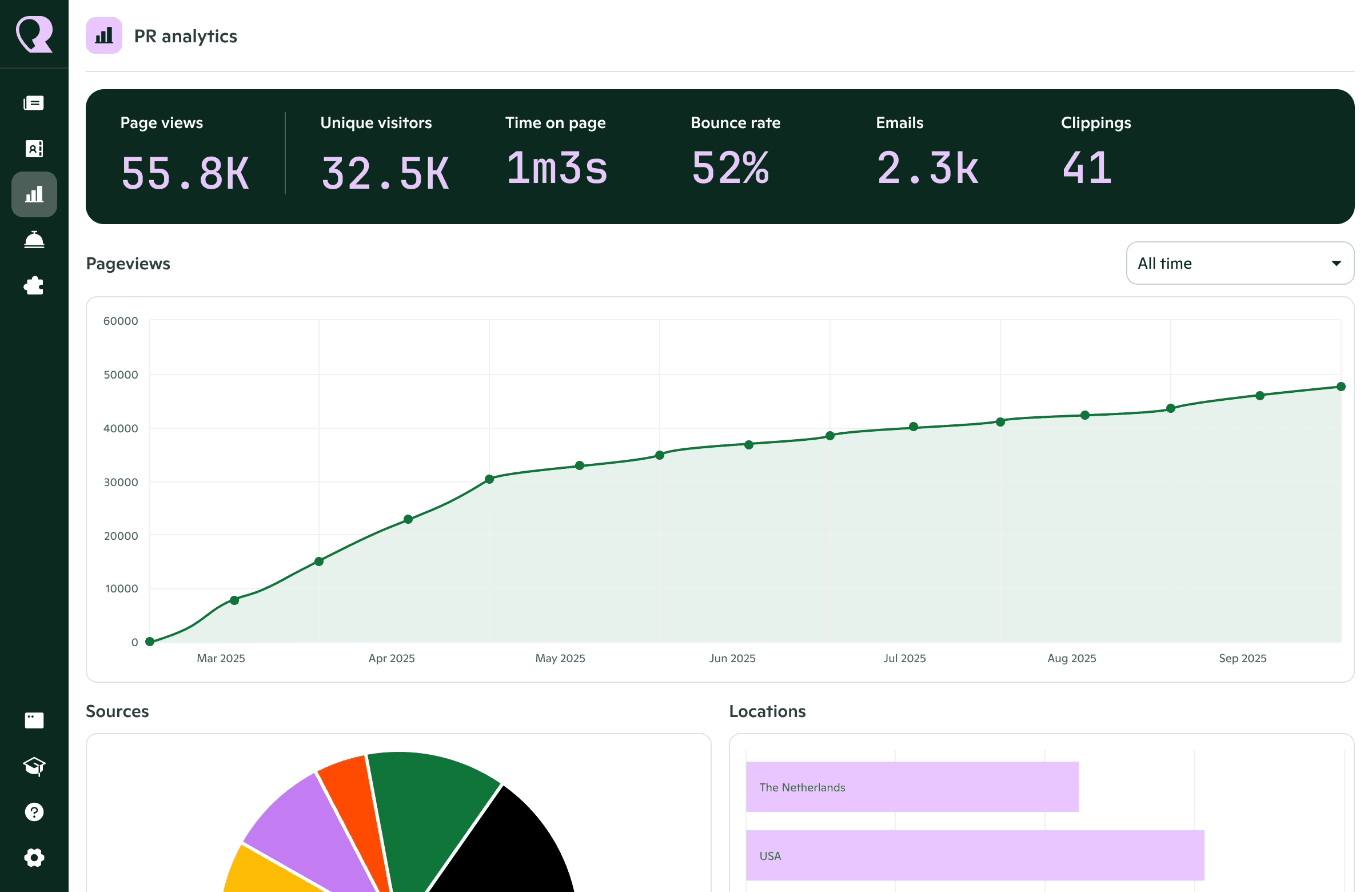
Additionally, the platform provides data on newsroom bounce rates, time on page, visitor geographic location and more. Together, these features offer a strong mix of metrics to help you fine-tune your PR efforts and keep your brand at the cutting edge of digital PR.
Con: Media monitoring is an optional add-on, and teams that need advanced social listening may still require a specialist platform.
What should you look for in a PR analytics tool?
Start with the question you need the data to answer. A long feature list isn’t useful if the software platform can’t measure the outcomes your team has to report on.
Media coverage
Check which countries, languages, media types and social platforms the tool monitors. “Global coverage” can mean very different things from one software tool to another.
Measurement quality
Ask how the platform calculates reach, sentiment, and SOV. Look for transparent methodologies and the ability to inspect the coverage behind the totals.
Reporting
The tool should make campaign reporting easier without reducing every result to one inflated number. Check whether you can customize reports, compare campaigns and separate high-value coverage from passing mentions.
Integrations
Consider how the platform connects with your newsroom, media database, email outreach, PR analytics and CRM. Manual exports are manageable until every monthly report becomes a spreadsheet-repair project.
AI visibility
If GEO matters to your strategy, ask which generative platforms the tool tracks, how often it checks prompts and whether it stores historical citations. A one-off prompt test isn’t the same as ongoing AI visibility measurement.
Price and usability
Custom pricing is common in PR software, so ask what’s included, which features cost extra and how many users the plan supports. A sophisticated platform nobody can operate is an expensive dashboard.
Choose the tool that matches the question
No single PR analytics tool measures every part of performance equally well.
Dedicated monitoring platforms can help you find coverage, compare competitors and track sentiment or SOV. Search tools show whether PR activity contributes to backlinks and organic visibility. Website analytics reveal what referred visitors do next. AI visibility tools add another layer by showing how your brands and sources appear in AI answers.
The right setup depends on what your PR campaigns are meant to achieve. A coverage report may be enough for a short media push. A global reputation management program may require monitoring across markets, languages and channels. A search-led campaign will need strong backlink and referral data.
Start with the decisions your team needs to make, then choose the tools that provide credible evidence for those decisions. And remember: More data doesn’t automatically mean better measurement.
PR.co brings newsroom publishing, media outreach, PR SEO, campaign analytics and more together to help you track how your stories perform from publication through distribution and engagement,. Book a demo to see our platform in action.
FAQs
1. What’s the best PR analytics tool?
No single tool is best for every PR team. CoverageBook is useful for fast coverage reporting, while platforms such as Cision, Meltwater and Onclusive are better suited to broad media monitoring and enterprise analysis. Search, website and AI visibility tools may also be needed to measure backlinks, referral traffic and generative search performance.
2. Which digital PR metrics matter most?
The most useful metrics are the ones tied to the campaign goal. These may include coverage quality, backlinks, referral traffic, sentiment, SOV message inclusion, conversions and AI citations. A strong report combines PR outputs, audience outcomes and business impact rather than relying on one headline number.
3. Can one PR measurement tool track everything?
Usually not. Many teams use a combination of specialist monitoring, search analytics, website analytics and AI visibility tools. All-in-one PR platforms can reduce fragmentation, but teams with advanced monitoring or social-listening needs may still require a dedicated product.
4. Is AVE still a useful PR metric?
Advertising Value Equivalency (AVE) gives earned coverage an estimated advertising value, but it doesn’t account well for credibility, sentiment, message quality or audience response. Most teams are better served by combining measures such as coverage quality, referral traffic, backlinks, SOV, sentiment and conversions.
Published
Last updated
Written by
Reviewed by

Subscribe to our newsletter
Stay ahead in PR & comms
Get expert insights on PR, communications, and AI delivered to your inbox.